
Photos by Ana María Camejo
(Editor's note: Due to a recent platform change, Zonagirante.com no longer has many of its archives online, especially those related to the Rock al Parque festival. As we prepare to cover the 2015 edition, we've retrieved photos and texts from last year, suspecting that what was said then still holds true today.).
Text written on August 20, 2014:
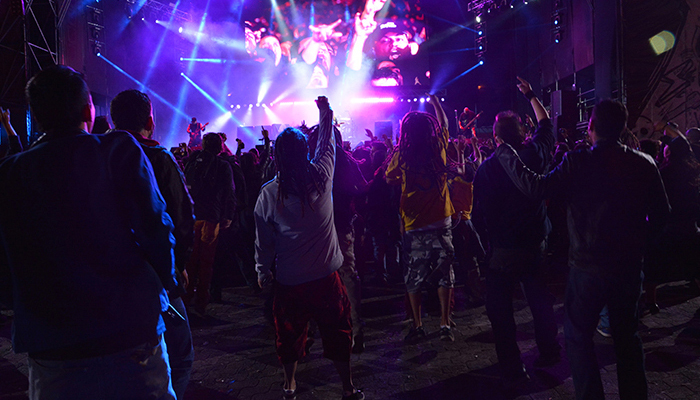
The photo is all over the place. An aerial image showing how absolutely packed the Simón Bolívar stadium was on the last day of [the event/conference/etc.]. Rock al Parquee, This clearly shows that attendance (as bullfighting aficionados say) was through the roof. It was to be expected. The lineup was attractive enough to ensure these numbers. Those of us who went to the festival can attest that the public was happy. The organizers' main objective was achieved. Officially, they're talking about more than four hundred thousand people over three days. Now, taking advantage of the happy faces of those in charge of the Bogotá City Hall institutions involved in this event, allow some of you, whom you consider unstoppable critics, to have a debate within the framework of respect we all deserve. Let's start with a question: The festival was good, but, aside from making us happy for three days, what else happened?
Let's start point by point: Every year, in these kinds of conversations, we reiterate the principle upon which this festival was founded, which was to foster and provide a solid foundation for the Bogotá rock scene. Yes, this includes having international guests, who in turn bring real exchanges with other musical scenes and complete an interesting lineup. Lately, it's been impossible to avoid the fact that there's been much more interest in visiting foreign bands than in local talent. This is understandable; we're in a scene with many areas for development, and a large part of the city's rock population is still unaware of Bogotá's existing talent. Bands aspire to perform at the festival, but they lack the solid foundation for the public to recognize them. The vast majority of Bogotá's bands haven't thoroughly explored the city's neighborhoods, and their communication with potential fans is limited.
Let's take a look back at its history: In the early years, the same organization that put on the festival also organized other musical activities throughout the year across Bogotá. We had events like Silent nights, Rapanrol night, where, during the Christmas season, a rock band would share the stage with a local rap project, and concerts were held to foster coexistence among different urban tribes. There were also the basement concerts on Avenida Jiménez, a location in downtown Bogotá, where every Friday night at least two bands would perform. Under the name Scary Shots, Performances were organized in high-crime areas so that culture could combat everyday violence. For one reason or another (perhaps lack of time, laziness, lack of media appeal, we don't know), this stopped, and everything was reduced to the festival itself.
If you take a map of Bogotá and look at where concerts are held regularly, you'll see that they're all concentrated in an area that occupies less than 101% of the city. Furthermore, if you look more closely, you'll see that most of these venues are nightclubs, catering to adults because alcohol is consumed. Here's an interesting point: we always hear some figures in the rock scene claim that free admission to Rock al Parque has hurt other events throughout the year because it has spoiled the audience. But no one considers that many festival attendees don't return to the bands' concerts because the venues are far from their neighborhoods, entry is restricted due to age (and in other cases, despicable classist decisions), and, besides all that, we're in a city with serious problems with nighttime transportation. From there, let me return to the Rock al Parque attendance figures and reiterate something: there is an audience for rock music in the city, but the music doesn't adequately reach all areas of Bogotá. For this to change, the Bogotá Mayor's Office must, at the very least, make its auditoriums and theaters available for these kinds of events. In Bogotá, each of the 20 local mayoral offices has auditoriums or spaces suitable for hosting events regularly. In some cases, these venues were built with significant investments, yet their utilization is quite low. The Mayor's Office should look among local business owners or staff from the local mayoral offices to find someone to organize these concerts. Without this, what we proudly call "the largest free festival on the continent" remains a major entertainment event for the city, but it doesn't truly contribute, beyond the three days of programming, to the development of the city's cultural industry.
Let's move on to another point: A festival of this size, with an investment approaching two million dollars, was organized, yet a proper press plan that effectively included Bogotá bands was lacking. There was no communication strategy to involve the groups selected through an open call to represent the Capital District from the moment they were included in the official lineup. All that was done was to include them in the largely unhelpful press conferences held over the three days, amidst the performances of the main artists on the program. We insist, at the risk of testing your patience, but if a new Bogotá band manages to participate in the city's biggest festival, they have every right to have their music and name known before their performance. This would give them a better chance of being covered by the media and, therefore, becoming known to the festival attendees. This doesn't cost the organizers any extra, and it is their obligation to do it.
On the other hand, I believe the answer to these and other problems in Bogotá's rock scene doesn't lie in bureaucratizing the various musical genres through specialized committees. All that does is empower individuals who prioritize their own interests and don't represent the sector. In trying to simplify things, they simply stagnate and listen to the wrong voices. Look at what happened with Hip Hop al Parque, how the supposed representatives of the industry handle everything related to that event, and see the result. Instead of fostering a genuine Union of Independent Musicians that includes the entire artistic spectrum and democratically discusses the whole musical landscape, they glorify individuals who claim to possess the absolute truth in their sector and who hinder the real progress the music scene needs.
One more thing: It might seem like a minor issue, but it's not. The Rock al Parque poster. It's become the running joke every year. Faced with clear and blatant plagiarism, flagged by the advisory bodies of the competition organized by Idartes, the decision was made to accept the "designer's" false word, sending a dangerous message: Here, when it comes to creative competitions, only cheats and idea thieves can succeed. It's also being said that there's no chance of finding good, genuine design in our city, which is completely false. Many other competitions organized by other cultural entities have already demonstrated that the right people and ideas exist, so why do the Rock al Parque competitions fail? It's time to do something about it, investigate how the bidding process works, who sets the competition guidelines, whatever it takes. But at this point, the only ones who can be held responsible for this matter are the festival organizers.
In short, there's much to discuss. There's much to debate, and we shouldn't be afraid of that conversation. We have to be clear that the figures presented in the press releases don't fix the shortcomings, and the crowds are there despite the problems. The final picture sends an incomplete message. We can be happy to see the image of the masses attending the festival, but those of us who have participated over the years in building this space cannot feel satisfied. It was three days of great joy; now we have to think about what we must do during the other 362 days of the year so that this is truly more than just a fleeting moment and a fond memory. The Bogotá City Hall must responsibly accept this debate and act accordingly. As Evita Perón said:“Where there is a need, a right is born.”"And that is the true political function to be fulfilled by the institutions, not simply entertaining the people.".
[metaslider id=732]