
By José Gandue @Gandour
Photo @simonamalaika
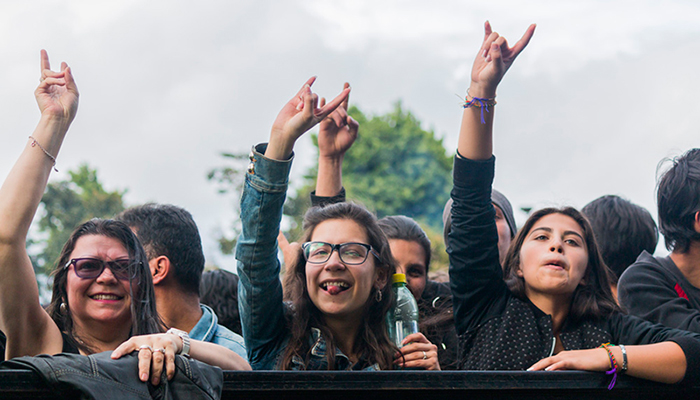
We spent an intense weekend in Bogotá, full of concerts, where we were able to attend in just a few days the Beautiful Noise Festival, to a good sample of metal in the Knotfest Colombia, a massive event with Fito Páez and a few medium-sized musical performances with an international character. Yes, of course, there is enthusiasm, there is optimism, and some are overflowing with emotion because of what they have experienced. Such is the ecstasy of some, that certain journalists, driven more by passion than by journalistic responsibility, have gone so far as to title their reviews "I disagree that this city is the world capital of music.". Patriotism, and perhaps the excess of festive drinks and substances consumed at competitions, makes us lose our sense of reality. Let's seriously discuss what we're experiencing around here and bring it down to earth properly.
Let's start with some exciting, optimistic data: Yes, Bogotá has grown culturally and, specifically, musically speaking. The comparison between what could be seen 20 years ago (and, if you prefer, 10 years ago) and what we see now is abysmal.. During wartime, the chances of seeing major pop and rock stars were slim, and it was said that the problem wasn't just the violence, but also the incompetence of the promoters responsible for these kinds of events. Several of them acted as if they were organizing a school fair, and others had shady motives when it came to investing in these shows (and it was painfully obvious). Some artists, especially those in the electronic music scene, were only willing to come if their fees were doubled or even quintupled to perform at disreputable parties that, frankly, did little to nothing to foster a local scene. More than one international booking agency was banned from any negotiations involving performances in this city and its surrounding areas, for fear of sending their clients into hostile and dangerous territory. Today, it is evident, there is more trust, greater professionalism, and all the infrastructure to be confident that a concert by, for example, The Rolling Stones or Paul McCartney will not have major problems in its execution and will attract a sufficient audience to cover expenses and generate profits for the organizers.
The quantity and quality of private festivals have also grown, and even after 24 years, public festivals in the park continue to draw thousands of people to their concerts., presenting, at the level of their budgetary capacity, musicians of the highest orbital level. We have seen how, even in small venues, we find some of the rising stars of contemporary genres for much of the year, and it is becoming increasingly clear that Bogotá is a very important meeting point on the Latin American scene, It is a city open (in some cases more so than some of the larger cities in the surrounding area) to receiving the most prominent figures from across the hemisphere. This is a city that has finally understood the importance of its geographical location and its connectivity to become a hub of the continent's cultural scene.
So far so good. Everything said up to this point is worthy of celebration. But, I insist, let's not exaggerate. There's still so much to do, and especially the most important things. We're celebrating the pomp, what looks good and makes for headlines in the mainstream media, but we're falling into a kind of irresponsible smokescreen.
Where are we failing?
Let's begin: Bogotá is a city that, according to somewhat imprecise figures, has between eight and ten million inhabitants. It is one of the thirty most populated cities in the world, and yet, if we seriously examine where musical activities are concentrated, These are only carried out in sectors that barely concentrate a little less than half a million inhabitants. There's a radical disdain for the rest of the residential areas, where it's assumed that people don't have enough money to attend shows. And we're not just talking about international events: Local talent itself shuns the possibility of expanding its presence, whether due to ignorance, comfort, or simple indifference, in areas that he has not investigated and that he views with fear.
On the other hand, the vast majority of musical events held in Bogotá related to contemporary genres take place at night., in places where alcohol is sold, and therefore the presence of minors is prohibited. The city's mayor's office itself, through its programs DC Live and, previously, Art Connection, It uses a significant budget to fund performances by bands in bars with these restrictions, instead of finding a more effective way to reach a developing audience. This does little to nothing to help the scene grow.
This is a city where, for its size, Auditoriums are scarce, and even more so are new local entrepreneurs to organize the activities. Every year the Chamber of Commerce organizes the Bogota Music Market (BOMM), which brings together a large part of the participants in the music scene and connects them with potential national and international buyers, but at no time has it shown any interest in increasing the likelihood of spreading cultural activities throughout all neighborhoods., training and supporting new generations of entrepreneurs who can profitably promote local artists. There isn't a proper music circuit in Bogotá, and mid- to high-profile bands (and obviously, not even those just starting out) don't get enough gigs to say they make a living from their music. If such a circuit existed, we would not only see that the most prominent musicians would have the necessary presence in the Colombian capital, but, speaking in purely capitalist terms, This would have a significant impact on the city's overall economic activity.
If we accept as true the claim that it is "the world capital of music," one of the factors that would definitely make us doubt that title is It's how little and how deficient the journalism in the sector is. Let us say it again: If we conservatively estimate that this is a city of at least eight million inhabitants, The number of radio stations broadcasting contemporary music is small., The major newspapers don't have a proper permanent music section, mainstream television only has depressing game shows related to the topic, and the vast majority of digital media, although growing, They do not have the necessary quality to meet the needs of the environment. Information isn't disseminated with the reach one would expect to feel like we live in a metropolis fully experiencing its cultural intensity. And that makes it so... music becomes even more of an aspirational and elitist product, contradicting that supposed spirit of development that surrounds us and which some talk so much about in their columns.
The motivation behind this article does not contradict the spirit of progress we have experienced in Bogotá in recent decades. Moreover, we in Zonagirante.com feels, without lying, that we have been part of that scene construction. We are proudly from Bogotá and proudly Latino. But let's not succumb to intellectual masturbation and pointless grandstanding, when in several of the points raised we are going down the wrong paths, and in others we still have a long way to go. To achieve great success and receive a label comparable to the one we use, we must integrate the vast majority of the population into the process; we must act more consciously in cultivating audiences. And we have an obligation to ensure that the entire music economy is solid and stable. Until then, let's leave the grandiloquence to those who want to sell us trinkets and continue to be the only ones who benefit from this whole affair.