
 By Emiliano Gullo @emilianogullo
Editor's note: We continue to delve into the archives of our brothers in ntd.la And we come across this fantastic tale of a Caribbean legend: Compay Segundo. Having passed his birthday a few days ago, we want to pay a fitting tribute to a brilliant representative of our continent's music.
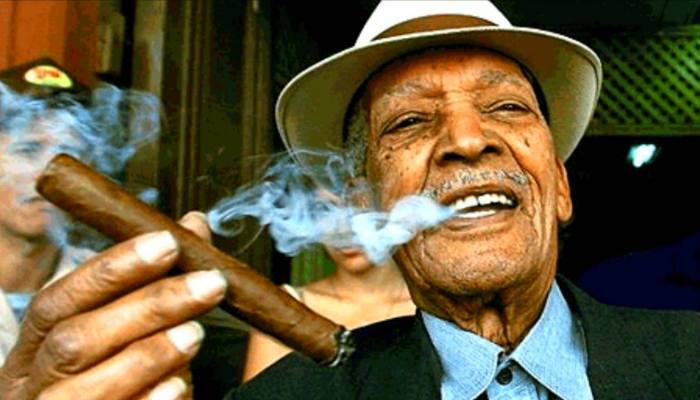
“There is one word that doesn’t exist for me: boredom,” he said. Compay Segundo on his 95th birthday, the last one who celebrated without ever abandoning his adolescent vitality. A tobacco worker by trade, Compay Segundo forged himself as a self-taught musician until he became the king of Cuban son, a genre that, through her voice, conquered the world. On that same birthday, she also said that her dream was to live to 106, like her grandmother had. He would have turned 110 this November 18th.
From a corner far south of Cuba, in the town of Siboney, the teenager Máximo Francisco Repilado Muñoz (Compay) He was making his way as a tobacco salesman. It was the early 20th century on an island populated by American cabarets.
It was thanks to his grandmother - a freed slave - that he was introduced to the world of Cuban tobacco. The myth will later say that he was not even five years old and had already tasted smoke. Over the years he joined the Montecristo cigar factory, the cigars that, with the liberation of the island, would become famous for being the favorites of Ernesto "Che" Guevara.
Only a few years had passed since the Spanish-American War (1898), in which the United States seized the island from Spain - among other Caribbean conquests - and Máximo was around., always close to rum and that six-string guitar that would blow everyone's hips away: the tres. The myth will also say that Compay Segundo was the inventor of the harmonic, a guitar style that adds a string tuned to the note G to the Tres.
He composed his first songs before the age of 30, by which time he had already been in several different bands. Santiago de Cuba. The Quartet of Eastern Troubadours, the Hatuey Quartet and the set of Miguel Matamoros, among others. In 1948 he joined Lorenzo Hierrezuelo and together they formed the duo The Compadres. But before they even hit the island, Lorenzo beat them to it. He claimed the first spot on the ballot and called himself Compay Primero. Máximo Repilado, then, was Compay Segundo.
Later he joined the sextet The Six Aces, he Cubanacán Quartet, and was a clarinetist in the Santiago de Cuba Municipal Band. Because Compay also played the guitar and clarinet, in addition to the tres. By the 1980s he was already a celebrity on the island with his musical group Compay Segundo and his boys. It was only with the topic Chan Chan that its name would be the Cuban embassy to the world. Thanks to that song, in the midst of the Cold War and the embargo, Cuban music filtered across all borders. Strictly speaking, great international recognition came ten years later. The song was recorded in 1987. But the real springboard was the record Buena Vista Social Club, in 1997, which featured the participation of other giants of Cuban son, such as Ibrahim Ferrer, Eliades Ochoa and the American guitarist Ry Cooper. Almost simultaneously came the final push: a documentary about the club, directed by Wim Wenders.
That same year, the Buena Vista Social Club album won several Grammy Awards in various categories. The following year, Wenders' documentary won the Academy Award for Best Documentary Feature. That's right: the world for Compay Segundo had become as small as his native Siboney. He composed more than 100 songs and sold more than 10 million records; he performed several times on every continent. Until the last minute of his life, he maintained his pristine smile and the smoke of his favorite tobacco; He died on July 14, 2003, at the age of 95, from kidney failure.