
By NTD.la Staff
(Editor's note: Another fantastic story taken from the archives of our brothers at NTD.la. Football, politics, and plenty of folklore surrounding an event that never ceases to amaze.).
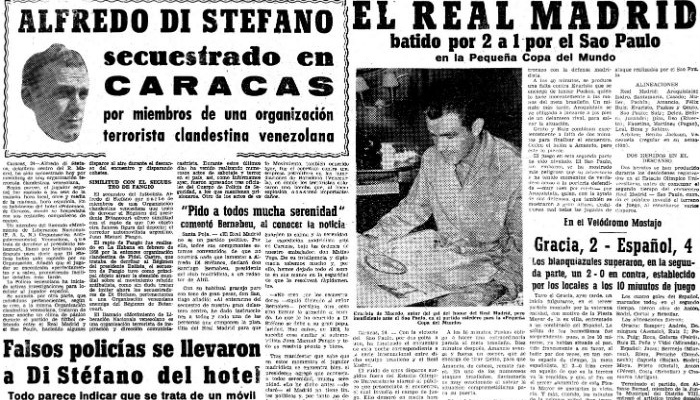
August 24, 1963 A guerrilla commando kidnapped the then best footballer in the world, the Argentinian Alfredo Di Stéfano. The group's leader was known by the pseudonym of Máximo Canales. His real name was Paul del Rio He liked being described as a Cuban sculptor and painter. Canales died in 2015 in Venezuela at the age of 72.
The first to announce it It was the ombudsman of Venezuela, Tarek William Saab. The Minister of Culture, Reinaldo Iturriza, joined in and also sent his condolences via Twitter.
Del Río was born in Cuba in 1943 and arrived in Venezuela in 1945 with his parents, those who had escaped from Franco's Spain. He was a member of the Revolutionary Left Movement (MIR) from the age of 17 and At 19, he was one of the founders of the insurgent Armed Forces of National Liberation (FALN) whose task was to unify his organization with the Venezuelan Communist Party.
Under the alias Canales, he led the group that On August 24, 1963, he decided to kidnap the Real Madrid star in the Venezuelan capital, perhaps one of the most famous men in the world. Real Madrid had arrived in Caracas to play in the "mini-World Cup" against São Paulo and Porto. The first match had already seen gunfire and chaos. But Di Stéfano, injured, had stayed at the hotel. Early the next morning, they came looking for him. The guerrillas claimed to be anti-narcotics police. They didn't give him or the concierge time to hesitate. And they took him to a tiny one-room apartment. The arrest lasted three days and the footballer didn't suffer a scratch.
It was just five years after Juan Manuel Fangio's kidnapping by Fidel Castro's guerrillas. The goal of the Cuban 26th of July Movement was to publicize its position to the world's major press outlets. And the strategy was not so wrong: just one year later the revolution triumphed. The FALN's arguments were similar. Silenced by the media and persecuted by the government of social democrat Rómulo Betancourt, they resorted to a dramatic stunt: a high-profile kidnapping, without causing any damage, that would put them in the spotlight. No shots fired, some lies, and a lot of smoke were the central strategies.
Years later, in an interview with the Spanish newspaper ASCanales acknowledged that there are no regrets or anger between them and the arrow:
How do you remember everything that happened?
Di Stéfano was at that time the biggest figure in the world and for us it was a propaganda operation, so that world public opinion would know about our struggle and the problems of the Venezuelan people who lived in an apparent democracy but under a corrupt government that was murdering us.
How did they plan the kidnapping?
The kidnapping lasted 72 hours. It was a tribute to Julián Grimau, a Spanish communist leader who was captured and executed in Spain by the Franco regime four months earlier. We launched a guerrilla operation in his name.
Aren't you sorry for what happened?
No, how could I regret doing good things? I'm still very proud of everything and I have nothing to regret. In fact, they've included the incident as an important anecdote in Real Madrid's history. It's proof that our behavior was correct and humane. It's an anecdote about the struggle of the people and of nations. I feel proud.