
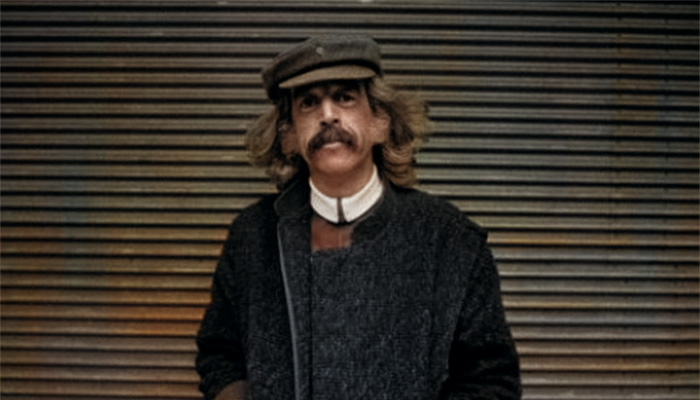
By Tomás Pont Vergés – @pontomaspont
Editor's Note: This is another of the fabulous articles published a few years ago in NTD.La, which we have access to at Zonagirante.com. We have published it, with the permission of our colleagues at that publication, because we felt the need to pay tribute to Eduardo Mateo, a remarkable Uruguayan artist whose work deserves to be remembered throughout Latin America. We hope you enjoy this incredible story.
He invented rock in the eastern part of the country, composed beautiful and incomprehensible songs, sold tickets on the street for shows he'd never perform, and raided every medicine cabinet in his friends' bathrooms. He died sad, lonely, and final; but since then, his work continues to grow. Eduardo Mateo He lived a life of humble origins and left behind a small but luminous body of work, with an influence on all the Eastern singer-songwriters who followed him. Jaime Roos, Fernando Cabrera, El Príncipe, Jorge Drexler or Martín Buscaglia are some of the artists who draw inspiration from his songs.
His mother Silvia cleaned the house of the concert pianist Eduardo Fabiani; for some, the most important classical music performer and composer in the history of Uruguay. For the rest of us mortals, he's the big-nosed guy who lends his superb profile to the 100-peso bill. She dreamed that her son would one day play the violin and piano at the Solís Theatre like Don Fabiani, and in his honor she named him Eduardo. But the boy lived far removed from sheet music and solfège lessons: As a boy he was a carnival musician, then a bossa nova singer, and when the British wave invaded the continent, he became a rocker.
Together with the Fattoruso brothers and Negro Rada, he literally created rock in Uruguay. But soon after, he turned the Beatles on their head, like Torres García's maps that put the south in the north. Together with Rada, they formed The Fifth: beat melodies and afro rhythms in their perfect dose. Long before Carlos Santana, they introduced drums to rock with their "candombe-beat".
The members of El Kinto were also the first to dare to sing in Spanish. Today the matter may seem trivial, but at the time it was a watershed moment; A small step for a band, but a giant leap for the history of rock in the Río de la Plata region. Kinto lasted from '67 to '70, where Mateo developed his particular style, with great songs like That Sadness y Prince Charming.
When the group disbanded, he moved to Buenos Aires, where, according to legend, he befriended Tanguito. He recorded at ION studios in Buenos Aires. Mateo alone, he licks himself well.. In the middle of recording a song, he told his engineer that he was leaving the room for a minute with a "I'll be right back" from the microphone. That day, without telling anyone, Mateo returned to Montevideo and never came back. The album would be released a year later, and would leave an indelible mark on a generation of musicians.
It was during those years that his personality was revealed in all its dimensions: his conversations were impossible to follow, his mood swings were unpredictable. He would swing from one moment to the next from profound melancholy to creative euphoria. His behavior was unpredictable, like that time in the middle of a performance when he announced a guitar solo: he placed the guitar on a chair on the stage and left the stage, never to return. Or like when, at one of his last concerts, at a festival on Pocitos beach sponsored by Coca-Cola, he made a toast to Pepsi. The psychoactive substances never helped. It started with amphetamines, which he replaced with cough syrup if the pill wasn't enough.
In 1973, the military seized power in Uruguay, and Mateo embarked on the darkest and most sordid period of his short life. With almost all his friends and colleagues in exile, He sought refuge for some years from political persecution and his own demons in Hindu spiritualism under the guidance of Guru Maharaji. The yogi Mateo coincides with the album Mateo and Trasante.
But good things never lasted long in Mateo's life: from one boarding house to another for non-payment, He ended up wandering around downtown Montevideo, rambling with himself, often in his pajamas. He was in and out of jail for forging prescriptions. Most of his remaining acquaintances in the city crossed the street when they saw him coming. He confronted those who didn't recognize him: “Hi, don’t you know me? I’m Eduardo Mateo. You’ve probably heard one of my songs more than once. I’m not asking for charity. I’m asking you to pay me a portion of my royalties. I’ve never been paid them.”.
The Samaritans who invited him to their homes for dinner would later find their medicine cabinets looted. Like that time the pianist Raúl Medina invited him to dinner at his parents' house. Seated at the table, Mateo, very polite and formal, asked the hosts if he could use the bathroom. After a long while, he returned with his hair wet and perfectly groomed, looking freshly bathed. Seeing the disapproving looks on his hosts' faces, he replied “Didn’t they tell me I could go to the bathroom?”.
In '84 he hit rock bottom and ended up in a psychiatric hospital. Upon his release, he found a place to stay: the dressing room of the Teatro de la Candela, where he played some nights and slept the rest of the time. There he composed the songs for his greatest album., Body and Soul. He died on May 16, 1990 from stomach cancer, which had been discovered two weeks earlier.
Eduardo Mateo never played at the Solís Theatre as his mother had dreamed. He probably slept under its door when he grew up. But his music did reach the legendary hall. In February 2015, the Montevideo Philharmonic performed a concert playing its repertoire. Perhaps in a couple of decades his mustache will also end up printed on some banknote.