
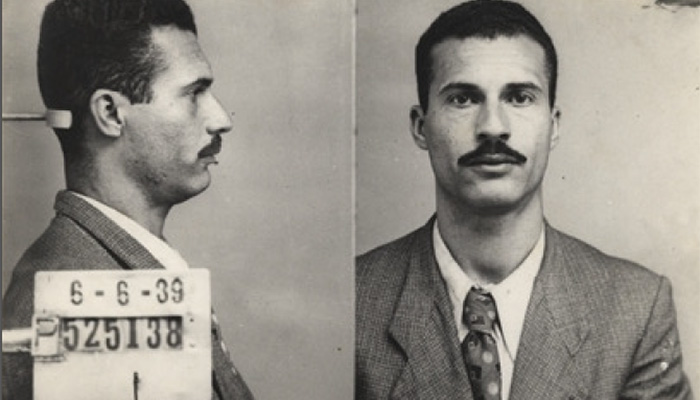
“A mulato baiano, Very tall and mulato Filho de um Italian E de uma preta hauçá
I was learning to read Looking at the world at a glance And paying attention Not that it was not in sight Assim a communist was born.”
Excerpt from A communist, Caetano Veloso
By Emiliano Gullo – @emilianogullo
(Editor's note: As we do every week, we turn to our brothers at NTD.la to recover for our audience's memory the fascinating chronicles and stories that remain in their archives, accounts that showcase the legends of the Latin American continent, men and women covered in bravery, madness, and glory for their causes that are worth remembering).
The Sky Tijuca cinema in Rio de Janeiro announces its main film currently showing: The master of the jungle, Starring Bob Hope and Anita Ekberg. Released in the United States in 1963, it is still a novelty in Brazil a year later. Among those who buy the ticket are Carlos Marighella, former communist deputy, poet, Marxist intellectual, revolutionary. The cinema is surrounded by soldiers. Escape is impossible, but resistance is not. Four soldiers are holding it up; Marighella, unarmed, stands firm in the face of certain death.
–“Down with the fascist dictatorship!», spits.
They shoot him three times. But it's useless. He survives and his figure spreads throughout Brazil as a living myth. “Public enemy number one,” the Rio press would say in those days. To imagine what this man meant in Brazil, one need only use the most popular scientific method. Indeed, the first Google result for the phrase “Brazilian guerrilla fighter” is Carlos Marighella. But Marighella was not just a guerrilla fighter.
The son of an Italian immigrant and a descendant of slaves, Marighella was born in 1911 in a working-class neighborhood of Salvador, Bahia. Before finishing high school in 1934, he joined the Brazilian Communist Party (PCB). That same year, Getulio Vargas would ratify his legitimacy as president at the polls after having come to power through a coup d'état. Just two years later, Marighella was arrested for subversion. Thus began a story of clandestinity, resistance, and Marxist indoctrination. The Vargas government understood the danger. Under Vargas's leadership there will be social policies, state development, and worker inclusion. And zero tolerance for leftists. He was imprisoned again in 1939. This time he remained in the shadows until 1945. In the December elections of that year, he was elected deputy for the PCB. But in those same elections, Eurico Gaspar Dutra, a military man with little affinity for communists, won the presidency and in 1948 outlawed the PCB.
Marighella went back into hiding. And, a few years later, Getúlio returned to power. Thus, now as one of the top leaders of his party in Brazil, he embarked on a revolutionary tour. He met with Mao in China and toured several cities in the Soviet Union. His return home was a shock. The United States, through the CIA, was increasingly infiltrating the country and its power structure. Vargas commits suicide in 1954. A coup d'état begins to take shape.. Finally, in 1964, Humberto de Alencar Castelo Branco rose to the presidency thanks to the force of Washington. The coup took place in March; and the bourgeois newspapers published his photo and ran headlines such as: Marighella, public enemy number 1.
Just a month later, in May, the army and police thought they had the guerrilla fighter surrounded. He was inside a movie theater. Escape was impossible. He doesn't escape, he resists and after shooting him three times in the chest they manage to put him in the patrol car. Thanks to a habeas corpus petition, the Court released him the following year. In the midst of the dictatorship, for many left-wing activists, the only option was armed resistance. Marighella understood it this way. In 1967 he broke with the PCB and traveled to Cuba to participate in the creation of the Latin American Solidarity Organization (OLAS). Upon his return he said:“In Brazil, only armed struggle, with guerrilla warfare as its best expression, can achieve the unity of revolutionary forces.”.
He founded the Marxist armed group ALN (National Liberation Action), with which he carried out armed attacks in major Brazilian cities, especially São Paulo and Rio de Janeiro. These actions included the expropriation of weapons and explosives, bank robberies, and the assassinations of businessmen who supported the dictatorship. The ALN grows through commando raids. Until one, in 1969, reverberates in the capital of the world. Marighella hears it on the radio from underground. “Revolutionary groups kidnapped the United States ambassador, Charles Burke Elbrick”. Joaquim Câmara Ferreira, ALN commander, had decided on this action unilaterally. The operation culminates in the release of 15 political prisoners. The diplomat is released safe and sound.
The State increases the pressure to hunt down guerrillas. Still underground, Marighella manages to finish and distribute the "Mini Manual for the Urban Guerrilla," which will circulate among militants for years. A few months later, the army sets a perfectly armed trap for him. He kidnaps several of his closest comrades. Under torture, they betray him. Marighella arrives at a supposed meeting. It's all over. As soon as he gets out of the car, he's gunned down from several vehicles; plainclothes officers, soldiers. Everyone fires. This time there's nothing the guerrilla fighter can do. The legend is 58 years old. And the whole story lies ahead.