
By Tomás Pont Verges – @pontomaspont
Editor's note: Regarding the Christmas publication of his compilation My man, the master of swing guitar, We wanted to pay tribute to the Argentinian musician Oscar Alemán, recovering a text originally published on the site of our brothers at NTD.la, which serves us perfectly to present this character, a jewel of the culture of our continent, whose story deserves to be reviewed again and again.
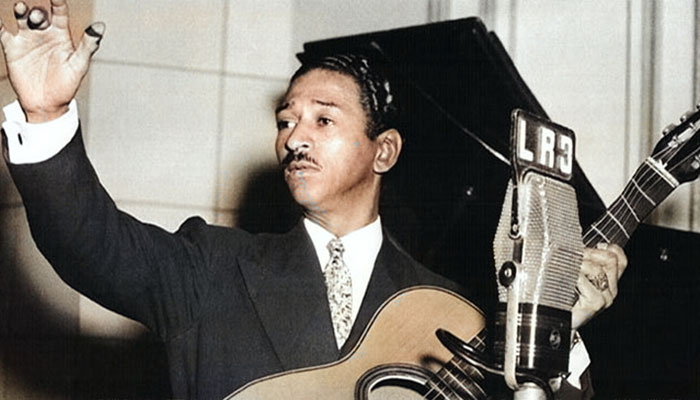
The only Argentine artist featured in every international jazz encyclopedia was born in the impenetrable Chaco region and lived a life worthy of a Russian novel. Theatrical and with an inimitable swing, he was a crowd favorite during a glorious era of Argentine music. A self-taught musician, he mastered almost every style of his time: tango, folk, bolero, and even Brazilian chorinho. Admired by the greatest of his time such as Duke Ellington, Horacio Salgán and Django Reinhardt, his troubled life surpasses any kind of fiction.
Oscar was born in 1909 in the heart of the Chaco region, in the town of Machagai, a land of cotton fields and quebracho forests. He was the fourth of seven children in the Alemán Moreira family. His father, Jorge, was the son of Spaniards. Her mother Marcela was from the Qom people, and she inherited her black complexion from her. Jorge and Marcela supported their children by picking cotton and chopping wood in the forest. Both had a passion for music. She sat at the piano and he recited improvised verses.
In search of extra income, his father decided to form a folk group with his children. They called it the Moreira Sextet. Like a kind of homegrown Jackson Five, the eldest son, Rodolfo, accompanied his father on guitar. Carlos and Jorgelina sang, and Juana and Oscarcito danced. The children were talented and entertained the audience., So the clan came to Buenos Aires in search of a promising future.
Upon arriving in the capital, Los Moreira had some promising performances. But when the initial excitement subsided, their hunger returned. Rodolfo died of tuberculosis shortly afterwards. Cornered, his father met a fellow named Figueroa who assured him they would be a success in Brazil. He packed his bags and left with four of his children and the promise that, if things went well, the rest of the family would join them later.
But the plan couldn't have gone worse. The little they earned on the tour was stolen by that guy Figueroa. Oscar's mother died in Buenos Aires, and the children who had been left in her care were given by the owner of the tenement to an orphanage. Upon learning this, his father threw himself off a tram bridge. The brothers who had accompanied him scattered throughout Brazil. Oscar, at twelve years old, was left living as a street child in the port of Santos.
Oscar focused on surviving: She collected bottle caps, opened taxi doors, and danced malambo for coins. Small in stature but endowed with extraordinary physical dexterity, he learned to box in street fights for tips from gamblers. Little by little, he saved up to buy his prized possession, a cavaquinho. He learned to play it by eye, imitating the finger positions of street musicians, until he could coax sounds from it. With only one song in mind, he began to go from bar to bar, passing the hat. Four decades later, already established, he would record that piece, which he titled OA1926.
At one of those tables where the melody was repeated, she met the person who would change her life: guitarist Gastón Bueno Lobo. It was 1924 and Oscar was fifteen years old. Bueno Lobo took him on as an apprentice and acted as a surrogate father. With him, he learned to play the guitar, and among other things, to read and do arithmetic. Together they formed the duo “Les Loupes”. They presented themselves as "Hawaiian guitarists" and enjoyed relative success that led them to tour Brazil and, by 1926, to settle in Buenos Aires where they remained for two years.
These would be the most tango-infused years for the man from Chaco, when his long friendship with Discepolín began. It was during this time that he composed the tango Guitar that cries. It features lyrics by the great Enrique Cadícamo, and the voice of Don Agustín Magaldi, the man who would fall in love with a precocious Eva Duarte.
The poet writes to the young German's guitar, telling it “You have a thrush in your throat / that you torture, as you unspeak your pain,”, And then he states, prophetically “You announce, I don’t know / what omen of betrayal / when your fatal vibration gives.”.
The verse would take on meaning five years later. Before that, Bueno Lobo and Alemán would have to embark for Europe, joining Harry Flemming's tap-dancer company. By 1932, settled in Spain, poverty struck again. Without bread and without work, Bueno Lobo learned that in Paris Josephine Baker was looking for a guitarist for her orchestra. She was the biggest star of the moment, with a Music Hall show that packed every venue. Lobo then left Oscar in Madrid and secretly traveled to the City of Lights.
During the audition, La Baker became interested in the guitarist. She had heard good things about Les Loupes, and the Brazilian was undoubtedly a good performer. However, his musicians whispered to him that the real talent was his accompanist. The diva politely dismissed him and called for that little black boy whom all her musicians admired. Outdone by his disciple, Bueno Lobo felt humiliated and returned to his land. Shortly afterward, plunged into a deep depression, he killed himself. Forty years later, in an interview with the magazine Siete Días, Alemán would confess that his teacher “When he found out that I was hired by Josefina Baker, he committed suicide in Brazil, in a public square.”. For the guitarist “His death and my father’s were the two hardest blows of my life.”.
Joined by the Baker Boys, he would live through a decade of fame and madness. He toured Europe, Africa and America several times, leading the band of the Ebony Venus, the most famous, desired and controversial artist in the world at that time. L'enfant terrible, As the star nicknamed him, he was a pillar of the show: he sang, danced, played the pandeiro, the maracas, any kind of guitar, and the double bass. He was also encouraged to do comedy, imitating the star during one act. During a visit to Paris, Duke Ellington was amazed by the skill of the man from Chaco. At the end of the show, the Duke approached her to offer her the position of lead guitarist in his Cotton Club Orchestra. The arrangement fell through despite Alemán's enthusiasm, due to the diva's stubbornness; she refused to hand over the factotum of her record company. Some maintain that Alemán and Josephine had a secret affair, and they cite the ballad as evidence. My Man, which she composed for her favorite guitarist.
In his free time, Alemán enjoyed the bohemian lifestyle of a Paris that was a party. In jam sessions He played at the legendary Hot Club with Henry Salvador, Billie Coleman and Louis Armstrong, Among others. There he would become friends with the ultimate genius of the guitar in jazz, Django Reinhardt, with whom he used to jam for long hours inside the gypsy caravan where the Belgian lived.
But Oscar Alemán's love affair with Paris came to an abrupt end with the city's fall to the Nazis. Although the guitarist volunteered to fight on the front lines, he was never actually drafted.. Attacked by an SS gang who beat him severely, he was expelled from the country, without a chance to take his savings and belongings.
He returned to Buenos Aires on December 24, 1940, with 84 pesos in his pocket, two Selmer guitars and his beloved cavaquinho. In his own country he was still a complete unknown. He then formed his first quintet, in partnership with the renowned Chilean violinist Hernán Oliva. Together, they quickly made a name for themselves in the highly competitive Buenos Aires scene of the 1940s, dominated by the great tango orchestras such as those of Troilo, Pugliese, and Maffia. The partnership with Oliva was effective, but short-lived. It would break down later when the violinist got into a fistfight on stage with the Greek magnate Aristotle Onassis., for whom they were playing at the Punta del Este casino at his birthday party.
Alemán became one of the leading figures of the legendary Buenos Aires nightlife of the 1940s. A night that never ended and wound its way through Corrientes, Lavalle and Florida.
The party began in the afternoon with his radio shows on Radio El Mundo, continued at night at the Richmond confectionery, and the box Midnight gong at four. Afterwards, a drunken jam session until all hours at the El Marabú cabaret, which was located right above his house, at Maipú 326. During the weekends, there was a marathon of concerts at popular dances in clubs like Lanús, San Lorenzo, or Chacarita, where more than ten thousand people could gather at each event. On those occasions Alemán showed off all his showman tricks, learned from his days in Paris, such as the famous guitar solo with his back to the audience. During those years he edited events such as his version of Kiss me a lot, which sold a million copies.
From the mid-fifties onwards, the good fortune of the string genius began to fade. Television, and especially the nascent rock and roll - which Alemán renounced - abandoned him to general indifference. Back on his luck again, with no contracts in sight, he turned to drink. He spent a decade forgotten. Hard years, in which, according to his own words, “He spent several Christmases eating only mate and bread.”.
Like a phoenix, his figure was reborn. And he did it again, as in each of those strange turns his life took, in an unusual way.
It was 1968 and Duke Ellington was visiting Buenos Aires. With half the city eagerly awaiting his visit, he performed at the Gran Rex for a week, with three shows a day. Upon arriving at Ezeiza Airport, Ellington angrily confronted the entourage, demanding to know where his great friend Oscar. Nobody knew what the idol was talking about until his saxophonist Paul Gonsalves explained that the Duke had requested that the first person he saw upon arrival be his admired Oscar Alemán. The producers rushed out to find him, not knowing what had become of him. They found him in his bathrobe in his apartment on Maipú Street, giving private guitar lessons to children. During the embassy reception for Ellington, Alemán played a few pieces on his cavaquinho in his honor. The guests, captivated by the American star, continued their conversation. Until Ellington, indignant, shouted at them all, exclaiming before German !This cat really has roots!
All eyes turned once again to the lost gem of Argentine jazz. Newspapers and magazines rushed to interview him. And he awaited them, his story wide open. For a few years he returned to the stage and even released albums. Having become a cult artist, he played until his liver gave out: he died in the Anchorena Sanatorium of cirrhosis in 1980.
Alemán was to Argentine jazz what Gardel was to tango. A truly popular and widely acclaimed artist, recognized by the world's leading figures of his time. A virtuoso on the strings, he created cosmopolitan music, pioneering the fusion of South American genres with jazz. A sound that was not the result of a conscious search, but of the extraordinary journey of his life.