
By Pablo Taricco – @tariccopablo
Editor's Note: We continue to reuse the archive of wonderful chronicles from our friends at NTD.la, and this time we're taking a transatlantic journey. We travel back to 1976, from Cuba to Angola, following the adventures of the singer-songwriter Silvio Rodríguez, in a story of song, war, liberation, and death.
When Antonio Agostinho Neto He requested military support from Cuba to defend Angola, as South African apartheid troops advanced rapidly toward Luanda from the south. From the north, the powerful army of Zaire, commanded by the eccentric Mobutu Sese Zeko He sought to seize strategic positions in order to later take control of the country. Despite the attacks, Neto resisted from the capital and also repelled the military advance of the internal forces that opposed his leadership. and to the Popular Movement for the Liberation of Angola (MPLA) that supported him.
It was 1975 and the Carnation Revolution had put an end to Salazar's dictatorship in Portugal It had also led to the independence of the colonies. Angola, Mozambique, Guinea-Bissau, Cape Verde, and São Tomé and Príncipe were on that list. In Luanda, the Angolan capital, a factional war fueled by foreign powers prevented the formation of an independent government. Africa was the new stage of the Cold War, And weapons, politics, and money from the east and west were flooding into the region. The situation was utter chaos.
When Fidel Castro He decided to send the first men towards Luanda, The prospects for victory of Agostinho Neto, the historic popular leader of the Angolan resistance, were still bleak. But after the success of the first missions, the Cuban-Angolan alliance became a fundamental pillar of that war which began in 1975 and lasted for two decades, with different intensities and under various formats.
Until 1991, Cuba maintained dozens of men in Angola. Nearly 450,000 Cubans passed through there, including soldiers, doctors, teachers, engineers, artists, and many others who were part of a mission that was dubbed “Operation Carlota” from Havana” and which today appears as a striking – and why not controversial – exercise in “internationalist solidarity”.
On her blog, Second Date, Silvio Rodríguez Remember that in the mid-1970s, many young Cubans were drawn to danger and adventure. Children of a revolution that came to power by force of arms, Those who had not been old enough to fire their rifles alongside Fidel Castro and Che felt a kind of debt, even a certain unease with the times. Silvio says:
“Subliminally, we were portrayed as saved from capitalist evil, from our past full of bad habits, but those salvations came with other unacceptable ones, such as the right to risk our lives (because others had already done that for us). It was unbearable to be safe from certain risks, and it was very difficult to accept that the “new man” had to “emerge” from that unbearably benevolent paternalism.”
When the call to arms in Angola became public towards the end of 1975, Hundreds of Cubans enlisted to participate in that war. In his book Silvio, Troubadour's Memoir of a Revolution, Joseba Sanz It details the queues at the Military Committees, and the tricks implemented when completing applications, white lies to fulfill the strange desire to go to war.
“Everyone wants their own Moncada” Fidel Castro was going to say this at the send-off for the first group of professional and volunteer soldiers who would depart that year for Africa. Silvio Rodríguez himself, who by then was already an important representative of the island's culture, He was going to try to use his political influence to achieve such a particular benefit.
Havana, December 15, 1975
Comrade Alfredo Guevara:
President of ICAIC
First, greetings, and without further ado, let's get to the point: I want you to give me the opportunity to go to Angola. The reasoning, I think, is obvious, the same one any revolutionary could offer. Furthermore, for me, someone who came of age during the years of Che's epic struggle and whose work has been largely inspired by internationalism, this experience has become an almost desperate need.
I'd like to go as a combatant, but I suppose you can't decide such a thing. So I'm just asking you to do your best to include me on the list of filmmakers who might go through ICAIC. I think I could be useful in writing scripts and, of course, in music and songs.
I want to let you know that I will do everything possible to uphold this decision. The path has been carefully considered and chosen calmly and without romantic notions.
With a fraternal embrace.
This is how Silvio Rodríguez seduced the Cuban Film Institute, of which he had been a part a few years earlier when he participated in the Sound Experimentation Group of that entity. But he was not the only one. Another troubadour, Vicente Feliú, then Pablo Milanés and other leading figures in Cuban music were going to enlist to travel to Angola to participate in that war.
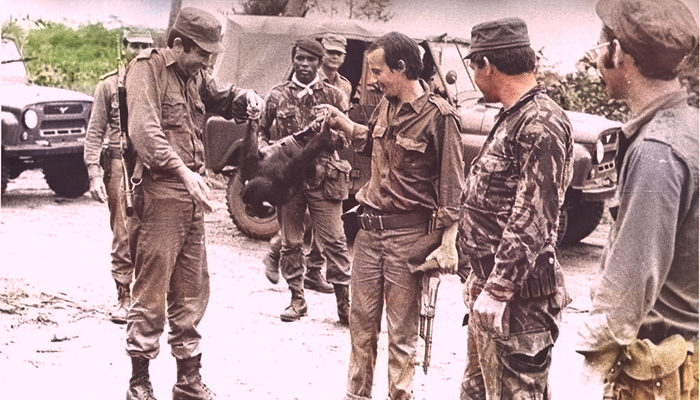
In early 1976, The Cuban government authorized the trip of what would later be known as the “Artistic Brigades”. Volunteers who had to travel along the battlefront to perform, sing, or play music in front of the soldiers. They would be armed, and they should not rule out the possibility of participating in confrontations. Ambushes were a reality, and they had to be prepared. By then, all adult Cubans had completed the island's mandatory military service., Therefore, basic weapon handling seemed to be guaranteed.
Before the trip, the artists were organized into three groups: The first consisted of the trova group Manguaré, led by Andrés Pedroso Chávez. The second was the group Los Cañas. and the third was made up of Vicente Feliú, Silvio Rodríguez, and the magician and illusionist José Álvarez Ayra.
They set off for their first African destination: Cabinda, a key city in the dispute over its significant oil wealth, But primarily because, geographically speaking, it is located outside of Angola, on the coast of the Congo. Cabinda, a sort of Angolan territory embedded within another country, was the city desired by the powers. Silvio and his companions arrived there. They were going to stay for 30 days in one of the main theaters of the battle for Angola's freedom.
His task was in some ways simple, but strange when placed in context. They were to sing: to gather at night around the fire, to raise the morale of the troops, to sing of heroism, freedom, revolution, and the values that had led them all to that country so far from Cuba to fight a war inspired by internationalism.
After a performance in Bocusao, in the Mayombe jungle, The military authorities decided it was too dangerous for the artists to return to Cabinda during the day. They would be easy targets for an ambush. They decided to begin their return journey in the early hours of the morning, and so they did.
According to Sanz in his book, at one point along the road in the middle of the night they stopped at Rodríguez's request. The commander ordered the jeeps' lights to be turned off so the troubadour could urinate. They soon resumed their journey and upon reaching a place known as Landana, they waited for another group of vehicles that was arriving late. One of the jeeps arrived with holes in it. They had been machine-gunned, but had managed to escape without casualties. The ambush had been at the exact spot where Silvio had asked to stop a few minutes earlier.
After spending a month in Cabinda, the brigade of artists had to continue their performances in the so-called "Northern Front"., exploring the area of San Salvador (today M'BanZa Congo), Noqui, Mama Rosa and Maquela do Zombo, along the border with Zaire
After completing the northern front, they traveled south, which was much more extensive, And they stayed there for more than three months. The military command assigned them a Mercedes Benz truck, two escort soldiers, AK47 rifles, a field first aid kit, some rocket launchers and a map showing the location of the Cuban troops. According to Silvio, he had to familiarize himself with the rifles, the RPG-7 rocket launchers, the Makarov pistols, and he even had to learn to drive a huge Soviet truck known as the Gaz-66.
But he also composed songs. From his experience in Angola were born The Seagull, Olives, Angola is a y Song for my soldier. According to Vicente Feliú, who participated in the brigade alongside Rodríguez, the story of this last song deserves to be told, and he does so in the book For whom love is due, by Ernesto and Guillermo Alemán.
“We had just received our uniforms on February 25th. Pants never fit Silvio well because he was so skinny., And since I learned to sew by machine from a young age, I take his uniform and start to mend it. At that moment I was informed that Commander Ciro Berrio Medina, head of the Political Section of Cabinda and second in command of the Political Section of the General Staff in Cuba, our friend in Cabinda, a dear friend, had fallen into a mine. He has lost a hand and they are trying to get him off unemployment. I go, I try to see him; they need blood, mine didn't work. I go to see Silvio, and when I knock on his door he's playing his guitar, and I ask him: "Are you composing?" "Yes." I don't say anything so as not to alarm him, until I see what happens. I go back to the hospital until, finally, after three or four respiratory arrests, Ciro dies. I came back devastated, heartbroken, because he was a very beloved person, and when I got to Silvio to give him the news, with an indescribable look on his face, he, beaming, said to me: "Damn it! Tinto, listen to what I just did!" And he sang me a song for my soldier. I was devastated, tears streamed down my face. "Damn it! What's wrong?" "Ciro just died." It was unbelievable. He was composing it while Ciro was dying, and so, evidently, it became known as Ciro's song. One of the most beautiful songs Silvio has written. Extraordinary.”.
Silvio Rodríguez was going to return to Angola at the end of 1976 along with Pablo Milanés to continue performing. That year would be remembered as the year the troubadours spent in Angola.