
By Loreta Neira @Loreta_L
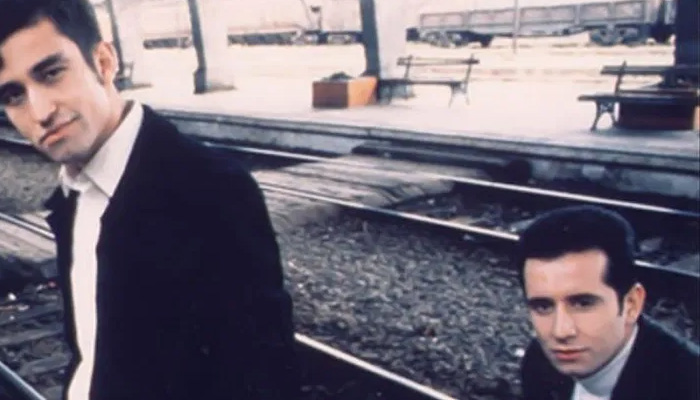
On May 20, 1990, it was launched into the world Hearts, the fourth album by The Prisoners And the first without their longtime guitarist Claudio Narea. Thirty years later, Chilean music websites and supplements are overflowing with articles celebrating that release as one of the most important milestones in the country's music. Each piece takes great care to examine the album from beginning to end and delve into the secrets of its creation, those juicy behind-the-scenes stories that every worthwhile work seems to have. And that's because for Chilean youth Hearts It was a kind of passionate love at first sight from which we could never recover. Every now and then we want to know more, to discover something new to fuel our admiration or to reopen an old wound that will bring back some powerful feeling. It's a danceable sadness that we love, and Jorge González fearlessly brought it to the radio. and with a conviction capable of breaking down heavy prejudices surrounding pop music, thus giving way to a new and vibrant chapter in the history of Chilean music.
With a history of protest rock with a rather... garage And from the neighborhood, the leader of one of Chile's most controversial and emblematic groups took a turn from his previous albums and opted for Hearts through electropop. Produced by Argentinians Anibal Kerpel and Gustavo Santaolalla, and recorded entirely by himself in Los Angeles, California, Jorge González delivered nine songs that allowed us to begin to savor the sweet and sour aspects of the mix between so-called "cebolla" music and the Anglo electronic dance music that was playing loudly in nightclubs. A lot synthesizer And the music resonated with lyrics that spoke with poetry and simplicity about life in Chile, about love, machismo, sex, and loneliness. Songs like Red hearts, Train to the south y Narrow-heartedness They became popular anthems in a country accustomed to singing about its sorrows, as the beautiful Chilean nueva canción taught us, accompanied only by an acoustic guitar., without knowing that anxieties could also be sung, and even danced, to the point of a keyboard and beat.
In addition to all the musical and socio-cultural analyses that have been made in and around the appearance of Corazones and that can be found in multiple corners of the vast universe called the internet, it seems important to highlight, even if only briefly, the school that this work has represented for Chilean and Latin American music. Chile being an important power when talking about contemporary pop Thanks to the work of musicians like Alex Anwandter, Javiera Mena, Gepe, PedroPiedra and so many more who circulate in the mainstream and the underground, It is difficult to even think about the existence of any of these projects without the prior appearance of the album in question. The embrace between techno and romantic ballad, the conjunction of love and politics, the problematization of certain social behaviors that were considered natural at the time And the right and importance of being oneself without disguises are just a few elements that the album released under the EMI Odeon label brought with it, inspiring all subsequent generations of Chilean musicians. Today it doesn't seem daring to say that without "Hearts" there are no "Rebels", no "Youth Schemes". “Corazones” explored a necessary freedom with a necessary rebellion. Without “Corazones,” Chilean music would be incomplete and would lack the sentimental revolution that continues to encourage many of us to say “let’s dance,” to sweat out our pain on the dance floor, on our bikes, alone in our rooms, singing loudly with our eyes closed, listen., I will not tolerate narrow-mindedness!