
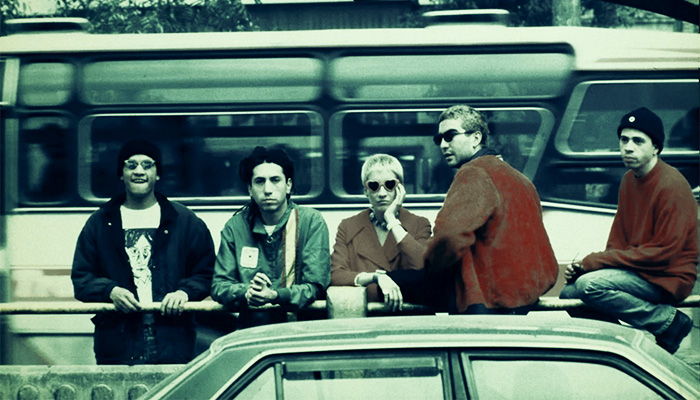
By José Gandue @Gandour
Many may find this statement exaggerated, But I have no doubt in pointing out that the most important album in the history of Colombian rock is El Dorado, from Aterciopelados. That said, let's clarify one point: If you ask me personally if this is my favorite album within the catalog of contemporary music from this country, I'll tell you that it's not even my favorite compilation within Aterciopelados' discography (I, personally, will always choose Atomic Caribbean, A flawless, well-rounded album with a cutting-edge sound and a magnificent song like it is Malignant, (which contains the best guitar work I've ever heard in any production around here). But, I insist: El Dorado It was one of the true starting points for beginning to talk seriously about Colombian rock. Prior to this production, up to that point, it can be seen as a collection of anecdotes, fortuitous and interesting events without much impact, and a lot of failed attempts to get things done. All of that, likewise, served to lay the foundation for what was to come; nothing was ever done in vain. Let me put it in musical terms: Before Aterciopelados' second album, the local rock scene was a demo with a lot of hope and a desire to move forward. El Dorado It was the first sure step towards the professionalization and internationalization of the new Colombian sound.
But what I'm saying isn't just based on sales figures, radio airplay, or other things that rely on gossip reports or music industry rumors. At this point, listening again to this compilation of 16 songs (including a re-recording of their first hit), Gala Woman, initially included on their first album, With my heart in my hand) and, regardless of which generation each of the listeners of the moment belongs to, Almost all of us can recognize several of those tunes and relate them to moments in our lives. Aterciopelados has been a vital part of the soundtrack of Colombians since 1995 (and before).
Allow me a personal anecdote at this point in the chronicle: A few months after it was published El Dorado, I went to study Audio Recording Techniques in Buenos Aires, and upon arriving, in the middle of the Southern Hemisphere summer, It played almost to the point of exhaustion. Rocker Flower on the main radio stations. . I couldn't believe it. It was funny telling my classmates at school that I knew Héctor and Andrea, wearing the same smug face I would have if I were telling them that David Bowie or Johnny Marr were among my friends. A few months later, Aterciopelados played in Buenos Aires, alongside the Chilean band Los Tres, at a place called Dr. Jeckyl. Of course, I went all out, going to their hotel to say hello and then, after the show, partying around the city. That night I was a groupie further. That day I felt proud to be alongside the true ambassadors of our musical community, treading on foreign territory.
Twenty-five years later I start to think and I realize that that window could not have been opened in that way if it weren't for Andrea Echeverry. Those who were meant to break the cycle of uncertainty in Bogotá's music scene at that time needed a powerful woman at the forefront, someone unconventional, with a strong message and enough charisma to inspire the vast number of female fans who, until then, had no rock figure to look up to. Bogotá's rock scene in the early nineties resembled a boys' club. It was an excessively male-dominated world, rife with chauvinistic displays from those who took to the stage trying to prove they were the most virile. Too much testosterone to attract the attention of female music fans. The day Aterciopelados performed alongside Caifanes in a packed La Santamaría bullring, I saw thousands of girls scream for the first time «"Andrea fought hard, she fought hard"». She was the idol, the one who called the shots. She was the one all those girls went to celebrate. She was the one who helped shake up the prejudices that existed about female talent in the Colombian recording industry, especially in its more alternative sectors. Without Andrea, we probably wouldn't have artists like Li Saumet from Bomba Estéreo or Catalina García from Monsieur Periné on international stages., to give the most successful examples.
In short, twenty-five years ago the Colombian alternative movement began to consolidate, and today, despite all the difficulties experienced and the skepticism of both supporters and detractors, We must say that since then, Colombia has gradually become one of the most important centers of contemporary music in the world. We can confidently say that one of the first steps taken to firmly begin that journey was this album, where a remarkable woman sang
«"Like praising yourself."
If you are a garden
With those smells
I feel like I'm dying.»