
By José Gandue @spinning zone
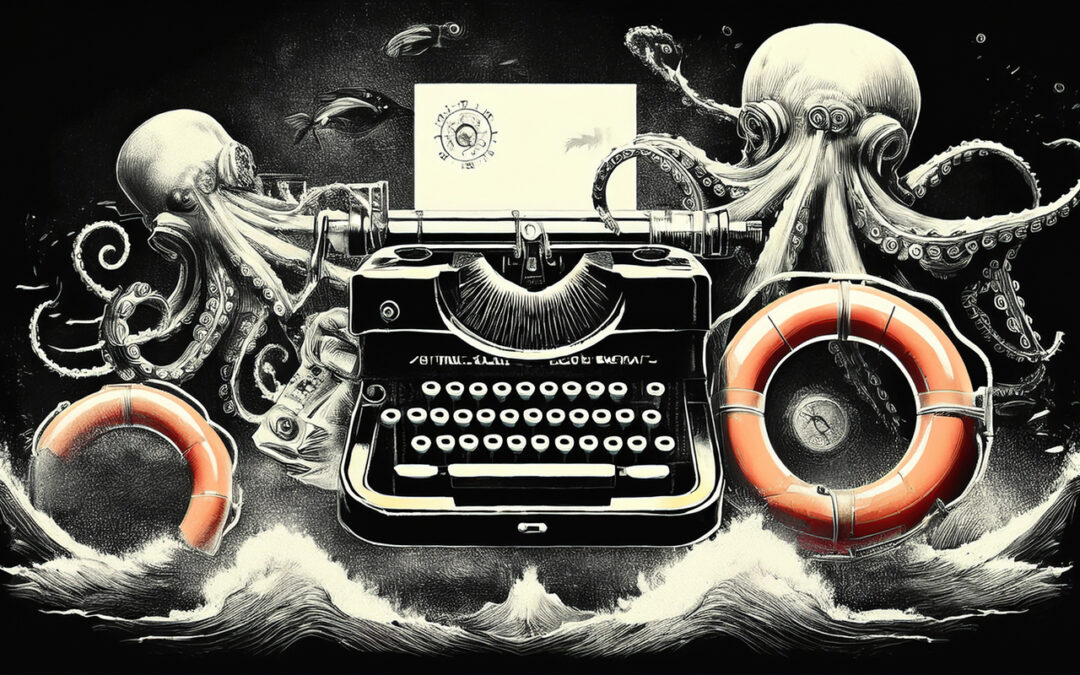
Cover art by Zonagirante Studio
An unlikely conversation between humans, algorithms, and songs that don't make the Top 40
There are days when one wonders, with a mixture of tiredness and happy stubbornness, why one continues to do this.
Why continue to support an independent cultural medium in 2026, when everything seems to be pushing in the opposite direction: speed without context, infinite scrolling, reviews turned into memes, music reduced to background noise for fifteen-second videos.
Zonagirante was born in another time, with different tools and different naiveté. But it's still here, mutating, adapting, breathing. And today, curiously, one of the things that has given me the most clarity about its purpose didn't come from a newsroom, a concert hall, or a bar conversation, but from long and honest talks with two artificial intelligences: ChatGPT y Claude.
I'm not saying this as a publicity stunt or a futuristic provocation. I'm saying it because those conversations helped me organize ideas that were already floating around in my head: about cultural journalism, about independence, about technology, about why it's still worthwhile to tell musical stories that don't fit the dominant molds.
And yes, I'll warn you right now: this text is influenced by AI. Not because it wrote it for me, but because it helped me think more clearly. And that, in itself, says a lot about the times we're living in.
1. Beyond the testimony on TikTok
We live in a paradoxical era: never before have so many people been talking about music, and at the same time, so few spaces where music is truly thought about.
There are testimonials, reactions, emotional unboxings, videos recorded outside concerts, threads of X that last as long as it takes the algorithm to yawn. All of that has value. I don't despise it. It's part of the cultural pulse of the present.
But there is also something that is being lost along the way: the idea of building memory, of weaving together contexts, of looking at complete scenes and not just viral moments, of saying "this matters" even if it doesn't have millions of views.
An independent cultural media outlet doesn't compete with TikTok or Instagram. It plays a different game. Or it should.
Not that of pure immediacy, but that of persistence.
Not the algorithmic validation, but the criterion.
Zonagirante doesn't exist to be the first to publish something. It exists to be consistent with a vision: Latin America as a creative territory, alternative music as a living ecosystem, culture as a long conversation, not a flash in the pan.
2. Independence is neither poverty nor epic
There's a romantic and rather toxic idea surrounding "independence":
as if it meant always living on the brink of financial collapse, working for free, burning out for a cause and smiling in the meantime.
No.
Independence should not be synonymous with precariousness.
Nor of martyrdom.
Nor of sterile heroism.
For me, independence means something much more concrete and much less epic: being able to decide what stories to tell without asking permission, without having to align them with the agenda of a brand, a political party, or a media conglomerate.
It also means accepting that we need tools, partnerships, and sustainable models. That absolute purity is a myth and that survival is also a form of ethics.
At that point, technology is not the enemy. It's an ally.
Including artificial intelligence.
3. Technology as the eternal suspect
All of this also explains why technology always appears in our conversations as an unwelcome guest.
Not as a savior, but not as a villain either.
There's something almost comical about how we repeat the same script every time a new tool appears.
The sampler was a “trap”.
Autotune was “heresy”.
MP3 was “the end of music”.
Now AI carries the same moral stigma.
There's always a moment of panic.
There are always guardians of taste announcing the final decline.
There are always indignant columns, solemn manifestos, speeches about the death of art.
And yet, history is stubborn:
The sampler didn't kill the music.
He created hip hop, modern electronic music, and new forms of sound collage.
Autotune did not destroy the human voice.
It became just another expressive resource, for better or for worse.
MP3 did not kill music.
It changed its circulation, its economy, its accessibility.
Today, artificial intelligence is going through its own cycle of demonization. And make no mistake: there are legitimate debates about copyright, labor exploitation, concentration of power, and algorithmic opacity. I'm not naive about that.
But there is also an automatic, almost superstitious reaction that confuses tool with intention.
Using AI to research, edit, think better, structure ideas, translate, explore references, does not make you a cultural traitor.
It makes you someone who wants to work better with the resources of their time.
4. Talk to machines so as not to be ignored by humans
There is something that deeply disturbs me about certain “anti-AI” discourse within cultural journalism:
that moralistic stance that almost always comes from places of privilege.
Because, let's be honest:
It is not the same to reject AI from a newsroom with a budget, designers, editors and paid time, as it is to do so from an independent project that survives on its own, from Latin America, with limited resources.
For media outlets like Zonagirante, artificial intelligence is not a futuristic toy. It's a lever.
One way to:
– write better
– research faster
– polish ideas
– translate content
– to organize scattered thoughts
– to compete, even if only a little, with giant structures
Not to replace human judgment.
Not to produce soulless texts.
But not to be ignored by the mainstream media, nor by the obvious prejudices against technology, nor by the logic of "if you don't have a newsroom, you don't exist".
In that sense, using AI from an independent standpoint is not surrender.
It is pragmatic resistance.
5. To tell what happens on this side of the world without cobwebs
One of the driving forces behind Zonagirante has been this:
to show what is happening in Latin America without falling into folkloric clichés, without the condescending filter of "exoticism", without the colonial gaze of the major media outlets in the north.
There are incredible scenes in Bogotá, in Buenos Aires, in Mexico City, in Lima, in Medellín, in Montevideo, in Santiago.
There are artists who don't fit into easy genres.
There are hybrid, political, intimate, experimental, rare, beautiful sounds.
And yet, they remain invisible to much of the global media circuit.
Because?
Because they don't generate enough traffic.
Because they don't have international PR.
Because they don't sound "sellable".
Because they don't fit into prefabricated narratives.
That's where an independent cultural medium still makes sense:
as a curatorial space, not just a coverage space.
As a place where someone says, "this deserves attention, even if it's not fashionable.".
And that logic isn't limited to long articles, interviews, or chronicles.
It also plays a role in seemingly minor decisions, in formats that many consider secondary, in editorial gestures that don't make noise but build long-term identity.
One of those decisions has a name: Women.
6. Women, playlists and decisions that are made slowly
All of this is not just abstract ideas.
It also plays a role in small, everyday, seemingly minor decisions.
Like a playlist.
Women It's not a new playlist.
It has existed for a long time.
It keeps growing, mutating, adding names, erasing others, breathing to the rhythm of what is happening on the scene.
What's new is not the list.
It's the way you look at it.
For years I did the obvious:
He would create playlists on music platforms and leave the link floating around, like a bottle thrown into the sea of streaming.
Useful, yes.
But incomplete.
Because a playlist without context is just a catalog.
And Zonagirante never wanted to be just a catalog.
Publishing Women's Magazine was a small decision in appearance, but big in meaning:
To surround it with words, with intention, with a look that explains why these songs are together, what they say as a set, what story they hint at about the independent female scene in Latin America.
This is not a definitive list.
It's not a ranking.
It's not an opportunistic move.
It is an evolving editorial piece.
Choosing what is played, what is named, what is linked, what is highlighted is still a political act, even if it doesn't carry a banner or a hashtag.
And yes: today those songs can be heard on Spotify and Tidal.
We use corporate platforms.
We live amidst contradictions.
We are not pure.
We are functional.
Independence is not about isolating oneself from the world.
It's about negotiating with him without completely losing your bearings.
Women is just one example, but it sums up well the kind of decisions that define an independent cultural medium:
not to do the bare minimum, but a little more;
not just linking, but contextualizing;
not just circulating content, but giving it meaning.
And from there, the question opens up again on its own.
7. Why continue?
So, I return to the initial question:
Why are we still making independent cultural media in 2026?
Because someone has to:
– slow down a little
– build memory
– provide context
– sustain invisible scenes
– write without thinking only about clicks
– experiment with formats
– Use technology without fear or fetishism
– to make a mistake in public
– to keep asking yourself questions
Because not everything can be reduced to metrics, KPIs, conversions and funnels.
Because culture is not a sales funnel.
It is a long, chaotic, beautiful, and profoundly human conversation.
And because, even in this age saturated with stimuli, there are still people who want to read something that is not optimized for anything, except to say something honest.
8. Provisional Epilogue
This text is not a manifesto.
It's a note in the margin of the notebook.
Tomorrow I might change my mind about several things.
Definitely the day after tomorrow.
That's also part of independence: not becoming stagnant.
Zonagirante is still here not out of nostalgia, but out of lucid stubbornness.
Because we still believe that music deserves more than a fifteen-second loop.
Because we still believe that Latin America is not a cultural footnote.
Because we still believe that technology can be a tool and not just a threat.
Because we still believe that writing is worthwhile, even when no one promises to read it.
And because, in some strange way, talking to humans and machines at the same time is helping us to better understand what the hell we're doing... and why it's still worth doing.
P.S. In case you haven't heard it, here's the latest update on Women: