
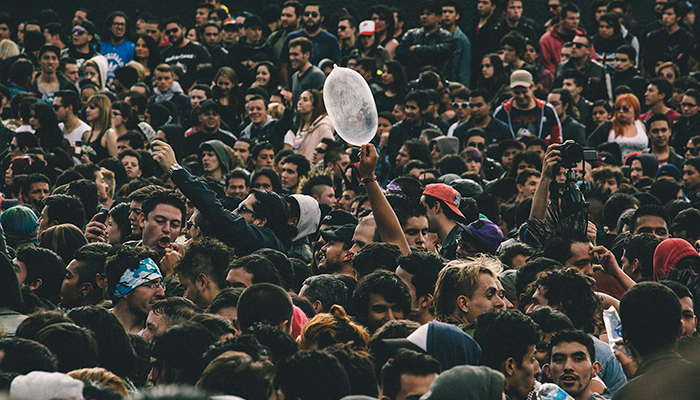
Photo by Oscar Perfer
We are approaching new municipal elections in Colombia and We, the residents of Bogota, have heard very little about the cultural policies that the candidates would implement if elected. It is an issue that does not seem to be among the platform's priorities and is addressed only tangentially, since the four candidates who are leading in the polls to occupy the position of mayor of the Colombian capital They consider it a minor issue, when compared to issues of security, mobility and employment.
At Zonagirante.com, we have dedicated a good number of articles throughout our history to the handling of cultural issues by different mayors. belonging to parties considered to be "left-wing"« who have been elected in recent years. In these notes we have observed, contrary to what we expected, opportunistic, electioneering, and politically motivated leadership, Starting with a mayor (Lucho Garzón) who one day got out of bed and promised the citizens that he was going to bring U2 for Rock al Parque and two hours later had to come out and retract it, up to today's dignitary, Gustavo Petro, who went to some of the darkest representatives of local hip hop to "smear" youthful energy during the most tense moments of the attempt to recall his mandate due to alleged irregularities in garbage collection contracts. During this time, we have seen the creation of the District Institute of the Arts, but we have also witnessed the waste of a large portion of the city's public spaces., concentrating artistic activity in a small area of the capital city. Today, we also see how officials from the different cultural divisions of the mayor's office are participating in the campaign of the current candidate of this political faction and They use documentary footage about Rock al Parque made 6 years ago to contradict rival candidates. There is much to discuss regarding the management of this political sector exercising power in the city in cultural matters.
But now Come with me to turn right To recall a particular story: In January 1998, a few days after taking office, Mayor Enrique Peñalosa gave an interview to the weekly magazine Suburbia., The publication where Zonagirante originated as a print section was held. The publication's director, the sales manager, and I attended the meeting. Throughout the interview, Peñalosa focused on the projects he planned to undertake during his term and how he intended to structurally transform Bogotá. When the conversation turned to cultural matters, he expressed his displeasure with his predecessor's accomplishments., Antanas Mockus, saying that the city wasn't going to change just by pampering traffic lights. I timidly asked him about the park festivals implemented by his predecessor, And he said quickly and arrogantly that the subject held little interest for him.
A few months later, when the dates arrived for announcing the calls for entries for Rock al Parque, I called employees responsible at the then Institute of Culture and Tourism, the municipal entity in charge of public festivals, to ask about the status of the process. After several evasive conversations, an official finally decided to answer me and told me that The festivals were not part of the administration's plans, among other things because such events "offended our elders". A few days later, Suburbia published an article about it, inviting Mayor Peñalosa to reflect on his decision. Within hours of distributing that edition, several people called the weekly's editorial office and asked if what had been published was true. Astonished, some university students organized themselves and began collecting signatures to demand the annulment of the measure. This initiative managed to mobilize more than forty thousand citizens who endorsed the petition, and the mayor's office was forced to reconsider its decision.
Peñalosa recently, now again a candidate for mayor, And while leading in the polls, he became displeased on a radio program when reminded of his initial decision to hold the festivals in the park during his administration. He denied everything, and his campaign questioned the journalist who dared to remind him of the incident. Four years ago, during a previous campaign, in an interview scheduled by Cartel Urbano magazine, I had the opportunity to address this issue, and the candidate refuted the claims, as they seemed to have vanished from his memory. Similarly, Peñalosa, who always speaks of exercising the office of mayor in a more "managerial" and less "political" manner, has never seriously considered the possibility of promoting the cultural industry in the city. And the subject, I suspect, bores him quite a bit.
The other candidates have said little or nothing about it. In a city of ten million inhabitants, which is clearly the artistic and cultural center of Colombia, and a reference point in Latin America, it does not seem logical that mixed or private institutions such as the Chamber of Commerce and Invest in Bogota have a clearer understanding of the economic and social potential of the sector than the public entities themselves. This goes far beyond thinking about a few concerts and the occasional theater or film festival. To discuss cultural policy seriously is to talk about job creation, about seriously adding this economic sector as an important contributor to the increase in the city's gross domestic product., of mechanisms to combat social inequality and the inclusion of population segments currently excluded from decisions about building a better city. There is much to correct and too much to do, and it is worrying how those involved in the electoral contest are downplaying the issue. Will there be enough time, before the elections, for the candidates for the political leadership of Bogotá to tell us their true intentions on the matter?


