
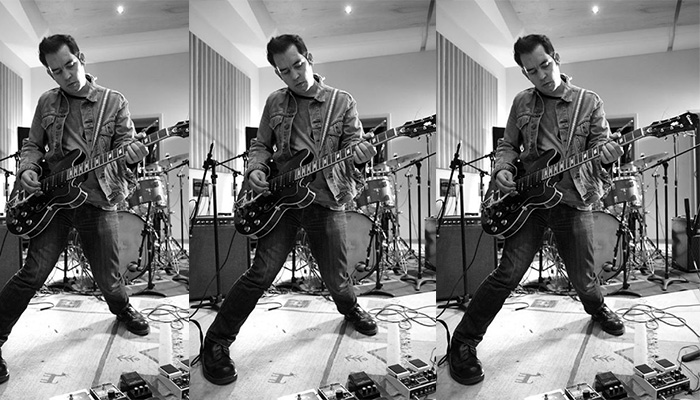
By José Gandue @Gandour Photos by Martín Santoro and Javier López Uriburu
I came across this album through comments from several friends on social media, praising the refinement and delicacy of its songs following its recent release. The feedback was so complimentary that it was inevitable I'd listen to this four-song EP and confirm that this small sonic package was brimming with unexpected splendor. This is what the Argentinian project presents. It's always midnight, led by Fernando Blanco (member of other well-known groups such as Valley of the Dolls y White Noise), has a nostalgic palate of the highest quality. Personally, the first reference I felt hovering around as soon as the first song played was that of the album released in 1994. Stoned & Dethroned, from the Scottish band The Jesus and Mary Chain. A beautiful, guitar-driven sadness, with calm rhythms, which fill the room with a reliable and gallant longing. The voice sounds calm, as if recorded with the tranquility of sunset, and what she says in the lyrics of the songs is perfectly believable:
«"I envy silence with all my heart."
dark winter, closed houses
I remember those days of long nights
"I demolish desperate nostalgia"»
In the end, It's Always Midnight EP I (that's the title of the first production of this project), it's very popular and that's why we sought out Blanco to talk about what he hopes to achieve with this work:
What is Always Midnight about?
Siempre es Medianoche is a project that began with the need to bring out my songwriting side, more akin to Velvet Underground, The Jesus and Mary Chain, Big Star, The Kinks, and The Beatles. I have another project much more closely related to noise, krautrock, minimalism, and shoegaze called Ruido Blanco (White Noise), which is a duo with two guitars and synthesizers that's more free of structure. I've also been playing guitar for 12 years in Valle de Muñecas (Valley of Dolls), an independent rock band with a long history in the Argentinian music scene.
What was the process of creating the EP like?
The reality is that more than an EP, this is an album that will be released throughout the year in three parts. This EP was released now, the second one will be released in two months, and the third installment will be the full album. In this era of streaming, A new project, releasing an album out of nowhere, doesn't make sense. You have to stretch out the timeline, deliver the material little by little, because otherwise, albums last a day and then they're gone. There's a lot of music out there, and musicians have to keep track of how long it's been around and release the material gradually. It's a good way to keep the listener engaged. On the other hand, I've been working on these songs since 2017, and they were recorded last year. They've evolved quite a bit from the demos to now.
You've already mentioned your influences, but how would you describe the sound of your project?
My idea from the production stage was to make it sound as 60s as possible. In fact, the demos had many more elements from the 80s and 90s and current eras, but I discarded them because I felt it didn't sound cohesive enough. In a way, Siempre es medianoche is my most sonically conservative project.
What do you find in Always Midnight that you don't find in your other projects?
First of all, these are my songs. In Valle de muñecas I only compose guitar arrangements, and in Ruido Blanco, although they are songs, the exploration is more about the sensory experience and the possibilities of sound than about composition.
What's coming up for Always Midnight?
For now, the second EP will be released in two months, and the full album by mid-year. In the meantime, I'm rehearsing with musicians to perform live what I'm currently hearing on [the EP/song title]. streaming.