
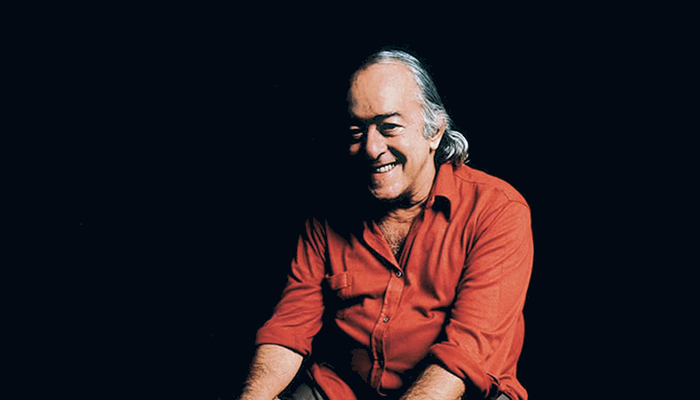
 By Emiliano Gullo – @emilianogullo Photo by Ariel Feldman
Editor's note: We are making this article available to you, originally published two years ago on our sister site. Ntd.la. It's a beautiful chronicle that respects the greatness of a great artist: the Brazilian Vinicius De Moraes. There's no better time to enjoy the beautiful songs left to us by this eternal master.
They say Vinicius was captivated the moment he heard the first chords of the guitarist who would accompany him on his first album. Joao Gilberto was playing. Chega de saudade fret by fret with an unprecedented rhythm under the musical direction of Tom Jobim. The three of them created a new musical genre in the mid-twentieth century.
Olympic whisky athlete, diplomat, musician, composer, poet, scholar, popular. Vinicius, a thousand men in one, He was born Marcus Vinitius Da Cruz de Melo Moraes on October 19, 1913 in the Botanical Garden neighborhood of Rio de Janeiro. “Vinicius was many Viniciuses. That's why he was from Moraes, otherwise he would have been Mora. And, at the same time, he possessed a beautiful simplicity. When we met, he dedicated a book to me that said, ”I am just a man.’”, "His ex-wife Marta Rodríguez Santamarina is laughing now in Buenos Aires, where she reminisced with #."NTD his three years of living together in Rio with the poet.
The life of the Rio de Janeiro musician began far from the stage. Upon finishing high school, he understood that the most convenient thing to do was to... It would mean studying Law and then trying your luck at the Itamaraty Palace, the emblematic Brazilian Foreign Ministry. She failed the first exam and only on her second attempt was she able to gain admission to the international relations program. Meanwhile, amidst the rigorous academic texts, Vinicius was dedicated to poetry. She had been writing since she was 10, but her first book O caminho para a distancia He published it in 1933, at the age of 20. It wasn't until 13 years later that he received his first assignment outside his country, as Vice-Consul of Brazil in Los Angeles, United States., He became interested in jazz and befriended intellectuals, musicians, and filmmakers, including Orson Welles. Always drawn to poetry, he also began writing film reviews. Music was becoming increasingly important to him.
Thanks to his diplomatic career, he traveled to Mexico, where he reunited with his friend Pablo Neruda. In 1960, on their way back to Rio de Janeiro, they wrote two texts expressing mutual admiration and affection. These two sonnets, along with other poems by Vinicius, were later compiled into a book after the Chilean poet's death. Natural History by Pablo Neruda. The elegy that comes from afar.
“Look, that’s Vinta’s handwriting. Look how clear it is.“, "Marta, who lived with Vinicius in the Rio de Janeiro neighborhood of Gavea from 1975 to 1978, delicately opens each treasure she brought back from Rio de Janeiro when she separated from the musician," says Marta, who lived with Vinicius in the Gavea neighborhood from 1975 to 1978. The one Marta is pointing to is the first edition of the book dedicated to Neruda. When they started their relationship, she was 22, Vinicius was 62. They met in Punta del Este. Marta was on vacation and learned that Vinicius was playing his last show at the Uruguayan resort. She waited for him at a restaurant.Upon arriving, the poet invited her to sit at the table, then to see his show in Montevideo, a tour in Sao Paulo and finally to live with him, to travel all over the world. Marta suspended her law studies in Buenos Aires and embarked on an adventure. “Then we went to Paris in ”76; by then I was Vinicius’s girlfriend. He was very down-to-earth. At his concerts, he’d bring his guitar, set up a little table with his whiskey, and that was it, everything was ready. He’d tell a story, recite a sonnet, and then start singing.”, Marta says.
“He had a very special perception of people. One day he told my brother: ”Carlitos, you have to be an actor; you’re a born actor’”. Marta's brother was 20 years old when he heard the poet's suggestion, whom time would prove right. Carlos Santamaría acted in highly successful series such as Los Simuladores, Sol Negro and Nueve Lunas, among others.
Vinicius's romantic history states that he had nine women. Marta was the second to last. But in one way or another, they were all his Girl from Ipanema. A kind of muse, a constant source of inspiration.
At least in composition, the Girl from Ipanema It was born from the lyrics of Vinicius and the music of Tom Jobim in 1962. If bossa nova was born with Chega de Saudade, with Girl from Ipanema he was going to conquer the planet. The story is well known. Vinicius and Jobim spent their afternoons among guitars, compositions and whiskey in the Do Veloso bar. And so they watched the curves of a woman pass by; she went back and forth always in front of their eyes. The golden-bodied girl from the sun of Ipanema, Helo Pinheiro, now 67 years old, She became a celebrity in Brazil. Of course, after walking distractedly towards the beach, with the song playing all over the world, the girl finally looked back. “Tom Jobim was in love with me, he even confused me, but in the end we ended up as friends in a relationship of affection and respect.”, Pinheiro recounted years later.
Musical acclaim came to Vinicius when he was almost 50 years old. He had recently been able to shed the burdens of his work as a diplomatic official. Now it was all poetry, music, and whisky—lots of whisky. He was 50 but had the same vitality as his "partner" Jobim, 14 years younger. The creators of bossa nova separated in '62, when Jobim traveled to the United States to work with Stan Getz.
Vinicius needed a new partner. His friend Sergio Buarque—a renowned Brazilian historian—frequently visited his house in Gavea. Along with him began to go one of his sons, Francisco Buarque. Chico wasn't even 20 when he started playing with Vinicius. He was his partner for years. In the early 1970s, the old poet met another virtuoso guitarist, a friend of Chico's. Antonio Pecci was the same age as Chico, and they had composed their first songs together. Ever since his mother had given him the nickname, everyone called him that: Toquinho. With his new partner, he traveled once again to Argentina, a country he frequently visited. But this trip, in August 1970, opened the door to the Río de la Plata music scene with his performances—and the recording he made with Maria Creuza—at the La Fusa café-concert in Buenos Aires. In truth, the recordings were made in a studio, where they invited people and recreated the atmosphere and ambiance of a bar. They later repeated the performances at La Fusa in Mar del Plata and Punta del Este. Vinicius had already played in Buenos Aires two years earlier, when he packed the Teatro Ópera with two shows. But from La Fusa onward, the Rio de Janeiro poet—friend and admirer of Astor Piazzolla– he became a central figure in Buenos Aires culture.
He was with Toquinho until the final day, July 9, 1980. That day the phone rang at Marta's house, who was already in Buenos Aires. She had resumed her law studies, but was working as a journalist. From her time in Rio, she remembers Vinicius's lack of concern for her health. "He controlled his drinking very well, although he would start drinking whiskey first thing in the morning.". But his body eventually took its toll. I went with him once when he was hospitalized for better control, but the next day he was drinking again. I got angry because he didn't want to take care of himself; it's one of the few arguments I remember.” On the other end of the line, they told him the worst news. Brazil's legendary star had suffered a stroke. He had five children, nine loves, and a thousand lives.