By José Gandue @Gandour Photo by Joa Rodríguez
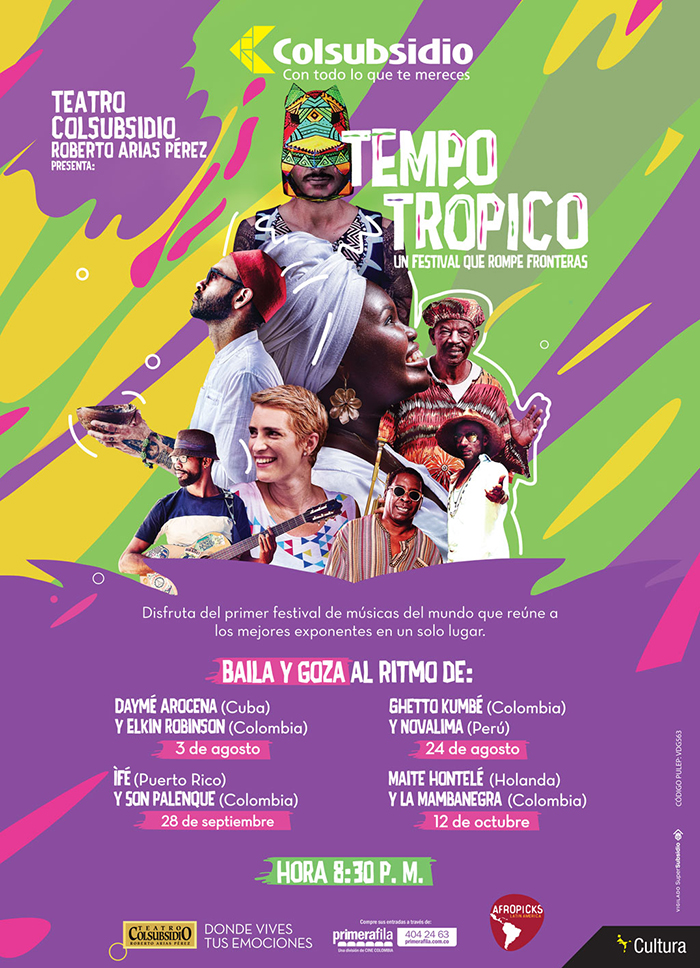
Between August and October, the Roberto Arias Pérez Colsubidio Theater, in partnership with the Afropicks music organization, organize Tropical Tempo,A festival that aims to showcase new sounds with African roots, venturing to present the region's latest fusion offerings for the enjoyment of fans. The guest list includes Elkin Robinson, Dayme Arocena, Ghetto Kumbé, Novalima, IFE, Son Palenque, La Mambanegra y Maité Hontelé. Artists from Colombia, Cuba, the Netherlands, and Puerto Rico. For this reason, we took the opportunity to speak with Simón Boichot of Afropicks to gain a clearer understanding of the event's purpose and scope.
What is Tempo Trópico about?
Tempo Trópico arose from a reflection between Afropicks and Colsubsidio. We realized that Colombian music was very present abroad and that the world was opening its doors to Colombian music, but that this same music, which is shining and touring extensively internationally, doesn't have much of a platform in Colombia in general, and in Bogotá in particular. Therefore, we wanted to open the doors to new world music on a stage, the Colsubsidio Roberto Arias Pérez Theater, to showcase the dynamism of this scene in Colombia and to present the best international artists.
How was the festival curated?
We at Afropicks are always observing artists, their trajectory, and what they do. The idea is always to bring cutting-edge proposals with international potential and innovative ideas. The concept, as it emerged, has always been to create a season that fosters a dialogue between national and international artists. That's why the themes are: "The New Sound of the Islands," which speaks to the new sounds emerging from the Caribbean islands, remembering that Colombia has an archipelago in the Caribbean and is part of this island Caribbean, with its own Creole culture, its traditions, and musicians who reinvent it and therefore keep it alive. Similarly, for Cuba, we're interested in Dayme, a very young artist with a spectacular voice and a novel artistic approach, who embraces the island's culture but also questions and reinvents it. For us, the way to prolong tradition and keep it alive is to make it evolve. A static tradition, inscribed in marble, belongs in museums, but it's no longer alive. What interests us now is the vitality that world music possesses. There's a big question: the definition of world music. Ultimately, this term, like many genres (like salsa, for example, see what Willy Colón says about it), is a marketing term, used to bring people closer to this music. It was coined by a great man, Peter Gabriel, with the best intentions in the world (in fact, he makes this music resonate worldwide with the WOMAD festivals), but its meaning has been lost; it's become just a label for foreign music.
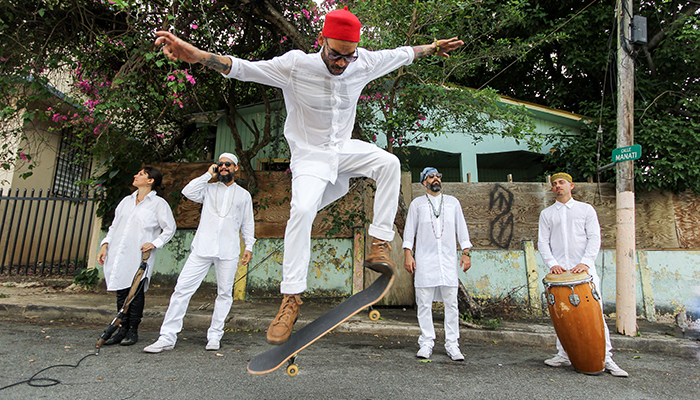
For us, it's very important to question this terminology, since all these bands don't define themselves as "rhythm music" (I repeat: it's a marketing term that aims to bring these different musical styles together and make them visible, but it has no musical definition: they are many different rhythms, melodies, and instruments that have nothing to do with each other but come from outside and open the mind, they take the listener on a journey): from Son Palenque (Afro-Caribbean music, they master this music from champeta to chalupa, passing through bullerengue and lumbalú) to Ghetto Kumbé (who define their music, with all their influences, as Afro-Latin beats) passing through Mambanegra and Mate Hontelé (who both reinvent salsa) or Novalima (who achieves a mix of global electronic sounds with Afro-Peruvian tradition and rhythms) and IFE (who play traditional Afro-Puerto Rican rhythms with samplers and beat machines and They evolve within the tradition of the IFA religion, the black Yoruba root of the island.
To put it better: we wanted to propose a sonic journey around the world. This year has a strong connection to African roots, as we've been working extensively with African and diaspora music through Afropicks. But that's not the only focus of Tempo Trópico. The idea is for Colombia to open its doors to external aesthetics, those that remain vibrant and haven't yet been standardized by globalization. There's a tempo that makes the world vibrate, that reveals its richness and beauty; this is the tempo of Tempo Trópico.
And we have been delighted to have the trust of an ally like Colsubsidio, who believed in our proposal and took the initiative to bring and develop this music in their theater, showcasing the cultural richness of Colombia and the world in a single space. We are very grateful for the support of this institution, which is also committed to making this music accessible to everyone, not just for the elite, with very attractive prices for its lower-income members.
Is the idea to hold this event every year?
This year is a first edition, yes, and we all hope it will be repeated.