
By José Gandue @Gandour
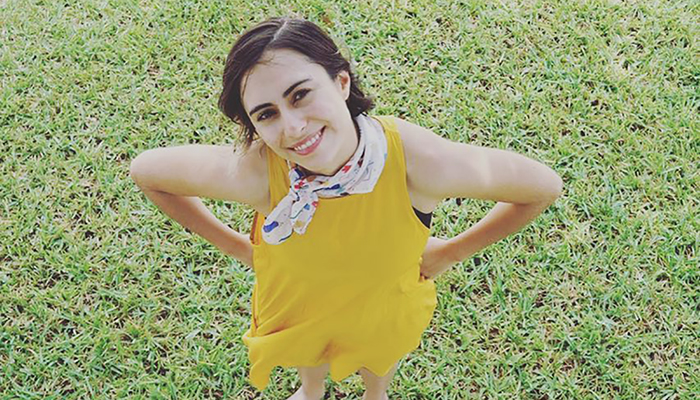
Her ID card lists her as Laura Restrepo. Upon hearing her, her Paisa accent is unmistakable. She speaks about what's happening in Medellín, her hometown, and speaks with passion about the city and her work contributing to its growth. Her artistic name is... Felisa, And that is where we hear her refer to her musical work and her commitment to the development of music in her environment and throughout Latin America, especially regarding the role of women in this environment. His compositions feature experimentation, intimacy, and a solid construction of melodies that are easily assimilated. Next month he will release his first full-length album, Real, on all digital platforms and has taken advantage of the Bogotá Music Market (Bomm) to promote her music in Bogotá. Therefore, we took the opportunity to meet with her. to conduct an interview in which we talked about her career and her cultural projects. A great conversation:
What does Felisa sound like?
It sounds like a fusion of Afro rhythms like R&B, hip hop, cumbia, bossa nova, etc., from the rhythmic and indie pop aspects, and in some songs even dream pop in the use of synthesizers and vocals. That, I feel, is the best description of their current sound. Real, my next album. Natural Geometry, My previous album had a sound that was closer to the Latin American indie pop made by artists like Natalia Lafourcade, Carla Morrison, etc.
Tell me a little about your musical origins, please.
My family isn't particularly artistic or musical. But my grandmother loves stringed instruments, and that's why she wanted her grandchildren to play guitar. She gave us all guitars made in Marinilla, but I was the only one who became obsessed with it. I would play it every day after school, and my parents saw how enthusiastic I was and enrolled me in lessons. Throughout my childhood and adolescence, I was always taking classes, singing in children's choirs, but when it came time to choose a career, music wasn't an option. However, while studying law, I made many musician friends (because the music faculty was right next door) and started singing in their jazz groups.
I was surprised to learn you were a lawyer, how does that work?
I think I learned a tremendous amount studying law. I had incredible professors, especially in subjects like philosophy of law, political theory, criminal law, and public law. I truly enjoyed my degree, but when I entered the profession, I felt like an oddball. That was quite difficult for me, and that's why I decided never to work in a law firm again. Now I've found a way to use the tools I gained from law school, but applying them to cultural management, copyright law, and the various business opportunities within the music industry. I'm very self-taught and I enjoy studying and learning new things.
What are your songs about?
About human complexity, about this existence. I also talk a lot about love, but not romantic love, rather the kind of love that transcends ego and is capable of feeling and empathizing with others. I like to write songs that show us we're not so different after all. Opinions are superficial; ultimately, we all want the same thing: to be loved, to be accepted, to be happy. And we all grapple with our fears, too.
How do you see the evolution of the role of women in the contemporary music scene?
I'm so excited. In fact, most of the projects I'm most excited about right now are led by women. For a long time, men took credit for many things that were actually the product of our creativity. Let me give you an example: a female artist would go to a music producer with her compositions, and the result would be a great album. Generally, the success, in creative and musical terms, was attributed to the music producer, usually a man. This has happened to me and to many friends I know well, how they made their albums. I think women are finally realizing that no one in the industry is going to do for us what we ourselves aren't willing to do for each other. Slowly, networks of work, support, and collaboration are being created, and that excites me a lot.
Tell me about your project Female Monologues. What is it about?
It's an open mic for women. It's a space for female expression where women feel safe to share whatever they want: music, poetry, stand-up comedy, dance, theater, short stories, etc. The most important rule of Female Monologues We don't judge, we don't curate art, because we want the microphone to be used not only by established female artists but also by women who may have never faced a microphone before. It's strange, but when you speak your truth and your feelings out loud, it creates a catharsis.
What developments have taken place so far?
I started opening the space in Medellín a year ago. Then some women from an audiovisual collective in Mexico City contacted me to do a Female Monologue there, and it just so happened that I was going to be there mid-year, so that was the first event outside of Medellín. And last Friday I did the first one in Bogotá. I won a grant to strengthen that project. A project done between Comfama and Ruta N. Right now I'm receiving personalized consulting to strengthen the concept of Female Monologues and its business model. I want it to work similarly to how Sofar Sounds works. That there can be Female Monologues in different cities in Latin America and that the work team in each city is self-sustaining.
Finally, what's in store for Felisa in the coming days?
A labor of love (laughs). I'm about to release my first full-length album. It took me two years to make, and I'm very happy with the result. I feel it's the best album I could have made at this point in my creative life, and that fills me with peace. It will be released on digital platforms on October 5th, and the launch concerts are on October 6th in Medellín at La Pascasia and on October 18th in Bogotá at Disco Jaguar.