
By José Gandue @Gandour
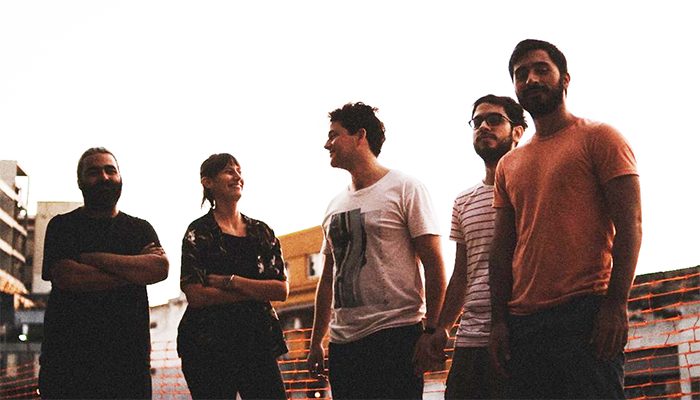
Bring your favorite sound blender and get ready, with your headphones on and the volume cranked up, to mix the following ingredients: A good portion of American Southern rock, a sensitive sample of Buenos Aires pop-rock with an attitude inspired by Gustavo Cerati and other musical heroes of the scene, drops of old-school jazz And, of course, a notable dose of blues to help shape the melancholy that explodes in each of the tunes of the final result. That's what it sounds like. I dress better in the cold., from the group Jauuar, A band comprised of four Venezuelans and one Argentinian, all residing in Buenos Aires. After releasing their album a few weeks ago, they have been promoting their material in the press with positive reviews and results., And that's why we were able to cross paths with Alfonso Hernández, his voice and guitar, so that he can give us more details about his history and his work:
Let's start with an easy one: What does Jauuar sound like?
Jauuar sounds like the lost son of Nick Cave who grew up in Latin America listening to salsa, Soda Stereo, and Amigos Invisibles
Does the sound change when you move to a different city?
Yes, quite a lot. Previously based in Austin, upon arriving in Buenos Aires they moved away somewhat from pop rock for something darker, more minimalist, but the blues, the vocals, the experimentation, and the profound lyrics only became more established.
Okay, tell me a little about the journey, what your trip has been like, where it all started and how things ended up in Buenos Aires?
We left Caracas, I personally in 2010, for Texas where I studied and worked for six years. I managed to travel, meet many people and see many different places, and for a while I didn't even make music, until one day I realized the void I carried inside me that I could only fill by writing and singing again. I decided that it was solely my own fault for neglecting it, and I picked it up again with humility and patience. I wrote and recorded an album that came out in 2016 called Casual Conversation, Then my US visa expired, and I decided to return to South America to try my luck in Argentina. I had a couple of friends there, and I've always loved Buenos Aires. It's been almost three years now. The band itself came together here. Through mutual musician friends, we got together "to see what would happen," and ended up recording the album: Pablo Mora, Hector Tosta, and me. Needing a female vocalist, thanks again to a musician friend, Mariana Michi, we contacted Margarita Ruben, who immediately agreed and recorded all her vocals in one afternoon. Then we decided to put together a live band, and Hector Miranda and Enrique Perez joined. We're all from Caracas except for Margarita, who's from Pehuajó, in the province of Buenos Aires.
Is there nostalgia for exile in music, or is it hidden without a trace?
Oh yes, of course. It's intentional; the first song They'll be there, The album seeks to capture precisely that feeling in its purest form. Then, other types of nostalgia, perhaps not so directly related to exile, remain present. Throughout the album, the feeling of being a foreigner is explored: you will never truly be from where you are or where you came from, but in the end, the world is what you make of it, how present you are in your life, that no one will be inspired by you, and that it's up to you to find some meaning in your existence. This last point is the cross of exile: you are what you carry with you, and no one is going to tell you what to carry. Well, except for a good jacket for the cold!
How have they been received in a field that is traditionally difficult for Latin artists of non-Argentine origin?
It's been pretty good, actually. We've made a lot of Argentinian friends who have opened their doors to us—to their studios, to their concerts. Some have even liked our music and presence and have invited us to share the stage. Overall, I don't see it as such an uphill battle because we're foreigners. We won't have the same network of contacts that some artists have, and our slang will be different, but if there's one thing that the "democratization" of the music industry has brought about, it's that musical quality, with minimal management, is recognized and appreciated.
What has been, so far, the best experience you've had as a band?
The Argentinian band Silvestre y La Naranja invited us to share a show with them at Usina del Arte, as part of the Ministry of Culture's Transformative Cycle. It was our first experience at a cultural event in the beautiful La Boca neighborhood of Buenos Aires, on a Sunday afternoon in September, watching the sun set behind the highway with the audience in front of us, all thanks to impeccable organization and the amazing vibes from SyLN. It was probably the most enjoyable experience we've had so far.
Do you dream of playing in Caracas?
Yes, absolutely. We all dream of returning and playing in a free Caracas, with true peace and opportunity for everyone.
Within your musical references (and apart from the aforementioned Amigos Invisibles), 'which Venezuelan bands serve as a reference for you?
Dermis Tatu, Cunaguaro Soul, La Vida Boheme, Viniloversus, Charliepapa, Todosantos, there are many more but I think those are the ones I can't fail to mention.
What have you found interesting about current Argentine rock?
Bandalos Chinos, Marilina Bertoldi, Usted Señalemelo, Siberianos, Las Sombras, Perras on the Beach, El Zar, Silvestre y la Naranja, to name a few. There are so many bands doing great things.
Finally, what's next for Jauuar in the short and medium term?
In the short term, a music video, shows, and probably some live sessions. In the medium term, new songs that we're already working on. Beyond that, the path will guide us. This will always be alive within us.