
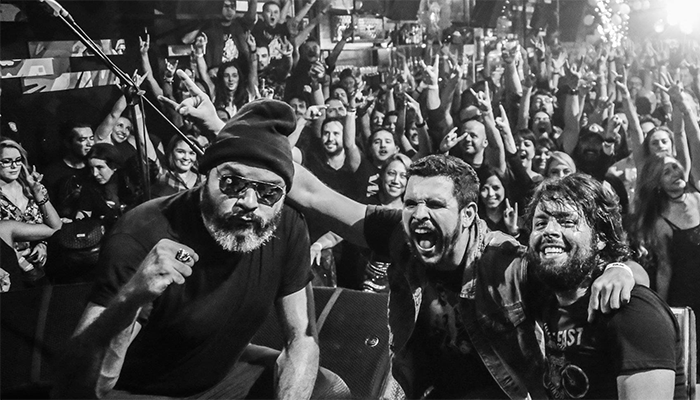
By José Gandue @Gandour
This trio, based in the city of Medellín, defines itself on its official Facebook page as «"A group of friends who never tire of creating and swimming against the rules to make music"», has embraced the arrival of maturity with fortitude. After his successful performances at various festivals, including a memorable show at the last edition of Rock al Parque, The Double A lance Peasant, A 9-song album, a challenging discourse on the reality of the country, without concessions or unnecessary caresses. During the 36 minutes of this production, everything feels like it has a theatrical structure, with diverse sonic chapters where every available resource is used. There are songs close to punk, others with a funk and cumbia feel, there's a hint of reggae on the fringes, but, In any case, it all ends up being rock, and powerful rock, without any restraint. This is a great album that should be among the best produced in Colombia this year, and for that reason we took the opportunity to talk about it with Nicolás Parra, the band's bassist:
After 20 years in the business, how can we describe the sound of La Doble A?
The Double A is rock and roll to jump, dance, get rid of bad energy, also to stop for moments, raise awareness and raise your voice.
How have they survived all this time, in a country where making rock music is a science, not to mention almost impossible?
We've survived thanks to our love for music. That's made us stubborn, determined, even obsessive, you could say. That's why we love rehearsing; we meet religiously twice a week to play. That's why we love recording, making videos, and of course, playing live. Over time, we also learned that to do all of that, we had to learn to communicate what we were doing better. We understood the importance of networking and the need to organize ourselves, divide tasks, and professionalize the project.
What is it about? Peasant, his new album?
The idea of Peasant It was born while we were filming through the municipalities of Antioquia, on a tour we do called «"The Muleteer's Tour". We thought it would be wonderful to bring rock and roll to the countryside and tell the story from there, regardless of whether the song's theme dealt with the country's reality, love, or simply having fun. Then, during that songwriting process, we discovered some beautiful things and wanted to pay tribute to those who deeply respect life and the land, and who unjustly suffer the greatest inequalities and social problems in our country.
How has this speech been received in one of the supposedly most conservative regions of Colombia?
Here in Medellín and throughout Antioquia, there are many people who breathe different air, as was evident in the last elections. These are people who resist through various movements and who find in songs like ours a release for that stifled cry that so many of us carry inside. It's necessary to talk about these issues to create a collective memory through our work, but also so that people feel supported, and so that those responsible for so many injustices know that we are aware of what they are doing and that we will not remain silent.
Are these times of change, or is it just an illusion?
Clearly, many people are awakening, but there is still a very strong discourse of hate that also has a profound impact. There is also a lot of misinformation, which is why we cannot give up; we must continue writing, singing, marching, always fighting for just causes, always encouraging others to do so peacefully.
Let's get back to the album: There's a noticeable eclectic spirit in the way each song is constructed. What was the songwriting process like?
We wrote the entire album in a cabin near Medellín, in the mountains. The music mostly always stems from the jam. We like to experiment with riffs, rhythms, and sounds. We also like to push ourselves a little to find new things. In the case of Peasant, We wanted to give a lot of variety to the songs to feed our live show with different moments. We think a rock show should be about jumping and going upbeat, but it should also have a lot of dynamism so that it doesn't become monotonous.
We also wanted to start with other rhythms and then bring them into rock and roll. So there are songs that originate from reggae, cumbia, disco, salsa, but are interpreted through our instruments and our distortions.
How do you feel about the current state of Colombian rock?
It's encouraging; successful events like Día De Rock Colombia in Bogotá or Carnaval Fest in Medellín, which are ticketed rock festivals, speak volumes about the current state of rock in Colombia. We've also noticed a significant generational shift at Rock Al Parque, Altavoz, and the Rock X La Vida Medellín Festival, where we not only see very talented young bands but also a very young audience, giving us hope that rock and roll is here to stay. We must continue strengthening the various scenes, encouraging small and medium-sized shows with tickets, further developing the network between major cities and their surrounding municipalities, and promoting the exchange of bands.
Finally, what's next for you in the short and medium term?
The next step is to present our album Campesino live. We're preparing shows in Bogotá and Medellín in December, and next year we'll have the Tour Del Arriero. The idea is to take it to other cities and towns in Colombia. Peasant He was born in the countryside and that's where he must return; we also have plans to return to Mexico in March and present the album there.