
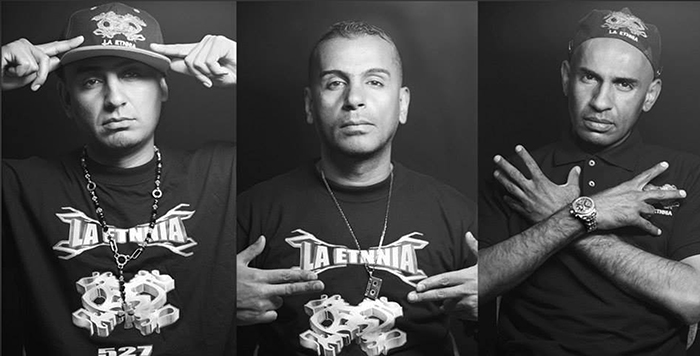
Listening to La Etnnia is to understand an important part of Bogotá's history over the last 20 years. Their sound is uncompromising, going straight to the heart of the city and portraying a reality that, no matter how much some tourist brochures try to downplay it, is there and hits you right in the face. La Etnnia is the most important group in the history of Colombian hip hop and, at the same time, represents the intelligent independent continuation of a musical enterprise that has survived for two decades. These days they are releasing their greatest hits album, Historia y leyenda (History and Legend), on vinyl, and we were able to meet with Kany Pimienta, a founding member of the band, to talk about what has happened during all this time.
Let's remember the beginnings of La Etnnia. How was the band formed?
Well, we started in the 80s dancing breakdance, influenced by the movies Beat Street, Electric Boogaloo, and Wild Style. Those movies were a huge hit at the time, and honestly, the environment where the scenes took place impacted us: the neighborhoods of New York and the beat, that beat, it changed our lives.
We started by copying dance moves, and as the days went by, we created our own. We formed a band called Los New Raperbreakers and brought the dance to downtown Bogotá, winning competitions in most of the clubs we played. But in the '90s, we decided to move on from that phase and continue in hip hop, but in other areas. We started writing songs, and honestly, that process was innate. We had some instrumental tracks from vinyl records, and we started improvising over them. By the early '90s, we had set up a small recording studio at home with some instruments like turntables, synthesizers, drum machines, and samplers, and we started making demos of some songs, which we began performing at venues around the city. We were clear that we had to come up with a solid proposal, and so when we had an idea we invited some musicians and when we were sure of the matter, we took the proposal to the Sincrosonido studios and there we had our first birth, which was called The attack of the methane, exactly 2 decades ago.
What did they see in rap that they didn't see in other genres?
Personally, the dance music blew us away. So did the graffiti, the streets, and the social commentary that Afrika Bambaataa, DJ Kool Herc, and The Furious Five were denouncing back then… It was incredible for that time.
We could say that rap is neighborhood music, since you have been identified from the beginning with your living space, with Las Cruces, were you always aware of this fact?
Rap originated in the barrio but permeated all social classes. Of course, we're aware of that.
Among the urban legends circulating, La Etnnia was associated with somewhat "gangster-like" anecdotes. Were these stories part of the Bogota myth or did they actually happen?
The truth is that La Etnnia is the voice of the streets of Latin America, and our surroundings have always been a source of inspiration for our songs. We sing about reality, about the streets and all their manifestations of life. About the current problems in the country, about heartbreak, about hatred. Imagine writing an album and looking back 20 years and seeing everything the same. It's an album that's timeless because of the situation and the series of things that happen and continue to happen within the system. The truth is, many of our stories are from the everyday life of a continent. That's why our lyrics have such a profound impact and transcend borders.
After more than 20 years, how do you see your influence on the sound of this city? Do you think your legacy still has the presence you hoped for?
Of course we've had an influence. La Etnnia transcends generations. There are parents who listen to the band with their children and then bring their grandchildren wearing La Etnnia t-shirts. That's gratifying, and the truth is, we created that style of narrating songs with a nuance and color that's instantly recognizable.
How does 5-27, your record label, work?
The truth is, we started two decades ago with a cassette (El ataque del metano), putting up posters all over downtown, La Candelaria, Chapinero, the north, and so on. Then we released the same product on CD, and from there we haven't stopped releasing music. We launched other bands like Tres Coronas, Full Nelson, Kontont, among others. We released several Latin American compilations and, with La Etnnia, we released four more albums. In terms of airplay, we've been supported by local and international channels that have played all our videos.
As clear leaders in Colombian rap, how do you see the state of the scene in this country?
The truth is, the scene is weak in many ways. When the record industry existed, there were no record labels or distributors for hip hop. There are few professional studios dedicated to this sound. There's also little support for attending paid events, since many people have become accustomed to the free events offered by the government. So when they have to pay for an event organized by a promoter, attendance is low. The entertainment business within the scene has grown very little, and to top it all off, there's the politicization of the genre: Recently, to prevent the recall of a politician, they mobilized the masses and conveniently targeted the rap scene. A few "pro-rap" institutions also emerged, masquerading as non-governmental organizations, requesting resources to teach people how to be rappers and keep youth away from drugs, etc., etc. They came out with that rhetoric and then boarded buses and minibuses with their tired old songs, speaking in the name of rap, and so on. Every day a new proposal is born in the scene but we are far from resembling the scenes of some advanced countries, where everything is handled totally differently and where what prevails is talent and the industry, show business, the big record labels and independent labels, and the great producers.
Is there any way to salvage anything from that situation?
I believe so, by becoming more aware, leaving mediocrity behind, professionalizing their work, and ceasing to think that Hip Hop al Parque is the Mecca of this movement. Many wait a year to debut, or to perform again, and that's how their lives slip away. The world is bigger, and we need to change that mindset because those who think small, remain small.
Speaking of festivals in the park, their performance at Rock al Parque last year was truly memorable. Somehow, material with 20 years of history was refreshed with that rock fusion they implemented. How did it go? Is it an experience that could be repeated?
Of course, the truth is we've always loved fusion, especially with drums, bass, and guitar; that's been the case since our beginnings. We felt really good, honestly, because we had a full band, all well-known professionals, and we hit the perfect balance we were looking for. We'd definitely do it again. People write to us a lot asking when the next gig is, and the truth is, there are some big surprises coming.
And while those surprises are happening, their new vinyl has been released. I imagine pressing this album has been a dream come true, hasn't it?
Yes, we're really happy with the result. We wanted to do it to cover the band's two decades of work. Eight albums, two songs each. Four songs per side, for a total of 16 tracks. A journey through the band's career, 1994–2014.
Okay, finally, what are the future plans for La Etnnia?
Visiting many venues and stages we haven't yet played, getting to where all those people want us to be and bringing them joy through music, and developing several projects that are already underway, all under the 527 brand and label.
More information about the ethnic group at