
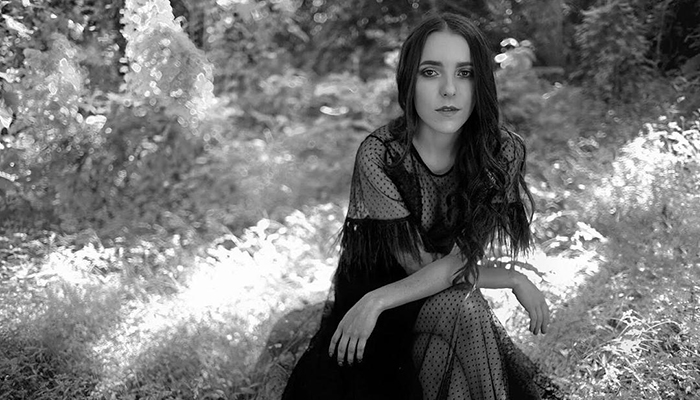
By José Gandue @Gandour Lolita de Sola's personal archive photos
We don't often hear stories like this: Ella, a Venezuelan woman now living in Mexico, initially presents herself in her press releases as a psychologist. If her story ended there, we probably wouldn't have published anything about her on Zonagirante.com and might have instead reported her comments in a medical journal or a mental health report. Fortunately for us, she dedicated herself to singing. To fully immerse herself in the profession, she studied Sound Design and Electronic Production at Berklee College of Music in Boston, and since then she has fused the two areas in her solo project. Lolita de Sola (that's his name), recorded six songs of his own authorship that were produced by José Luis Pardo –DJ Afro, from Los Amigos Invisibles– in New York, releasing her first album in 2018, it's called Cattleya, Remembering one of the most beautiful orchid species on our continent. This compilation of songs It can be defined as pop, fueled by textures of jazz, bossa nova, trip hop and other influences, resulting in an attractive work with a simple and pleasant sound. Taking advantage of her visit to Bogotá, we were able to talk with her and get to know her better:
Tell me a little about your story. I see you're a psychologist by profession, but fortunately you dedicated yourself to singing. What made you take that path?
I'm a psychologist by profession because, honestly, when I started thinking about my career path, my family didn't support me pursuing music. They always told me to have a "plan B," so I decided that would be psychology. After finishing my studies, the only thing that made sense to me was to pursue music, even though being a psychologist greatly influences everything I do—why I do things, how I do them, and what my purpose is. It really does influence my songwriting. But the truth is, since I was a child, I always knew that music was my calling: composing, writing, singing, and producing. Currently, I try to encompass all those aspects of music.
Besides, who said that practicing psychology guaranteed a stable future, right?
Exactly (laughs). Maybe it's a more traditional one, but not entirely stable, since it's truly a career that requires a lot of emotional self-care so you don't get drained by other people's sorrows (although, well, music is kind of like that too), (laughs). Maybe I was never destined for something stable.
Speaking of instability, how do you make music in exile?
That's an act of faith. We Venezuelans had to take a leap of faith into the unknown because of the crisis in my country. I chose Mexico, and the truth is, I've had opportunities, and I take every one I can, always hoping that all this crazy effort will lead me somewhere.
There is a strong community of Venezuelan musicians in the Federal District and surrounding areas, how have they been received?, how do they function as a guild?
Yes. There really are a lot of us. Almost all Venezuelan musicians decided to go to Mexico. I feel it's a close-knit community that supports each other, even though it's not all sunshine and roses. I've also seen how many have worked hard and dedicatedly to make their projects a success. The Mexican audience is very welcoming. I can say that, so far in my short career, they've been the most welcoming, enthusiastic, supportive, and fanatical (laughs), so to speak.
What do your songs sound like?
Lolita De Sola. Hahahahahahahahaha. How conceited, right?
What does that mean?
My songs are an extension of myself. With what I've done so far, I've truly sought to experiment with music, to bring my truths to light through lyrics, and to be inspired by incredible artists who have filled my life with music. But I haven't tried to sound like anyone else, and perhaps that's my biggest mistake or my greatest success—only time will tell. I strive to be pop. But I'm heavily influenced by electronic music and jazz. I'm eclectic. And my style is, I think, having no style.
Likewise, you must have some role models, or at least artists who inspired you, right?
Without a doubt. I wouldn't have done anything without the work of Jorge Drexler, Gustavo Cerati, Natalia Lafourcade, Corinne Bailey Rae, Björk, Cultura Profética, Bonobo, and Radiohead. To name a few.
What are you doing in Bogotá?
I'm promoting my first concert here. It's on Friday, August 16th at La Roma Records. It will be an intimate concert and my first time performing for a Colombian audience. I'm scared (laughs).
Really? What have they warned you about regarding the local audience?
Well, to be honest, not much! I haven't looked for any references. I'll be surprised on Friday to see what happens. What do you think? (laughs).