
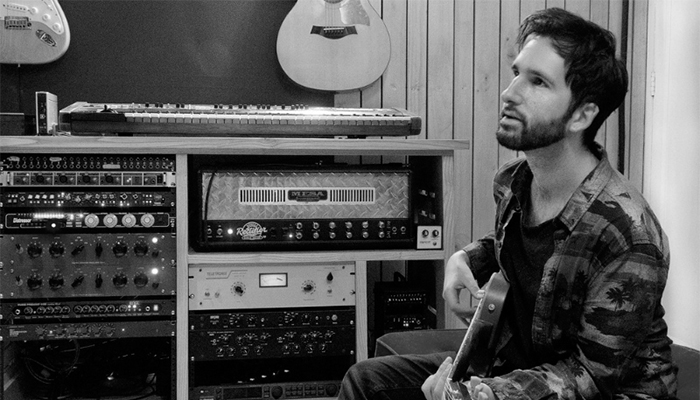
By José Gandue @Gandour Photos from the Pablo Stipicic archive
If we review the information labels of the latest Chilean independent music albums, in some of their most interesting releases, including those of Rubio, We are the Grand, Home Appliances, Vicente Cifuentes, Fernando Milagros, Gianluca and others, the name of Pablo Stipicic. This musician and producer has been gaining recognition for the past ten years, winning prestigious Pulsar Awards for his work and attracting attention from wider markets, particularly Mexico, with the aim of expanding his reach throughout Latin America. In Mexico City, while Stipicic was busy meeting with potential clients, we managed to catch up with him to learn more about his work and his perspective on music in the region today.
What does being a producer mean to you?
For me, a producer is someone who accompanies the artist throughout their process, helping them to best express their vision, their aesthetic, their message. This "accompaniment" ranges from artistic and conceptual aspects to technical ones.
What particular element do you think distinguishes you as a producer?
I believe I have managed to build a "sound," an aesthetic, so to speak, while also being versatile in terms of the genres I have worked in.
Tell me a little more about that "sound", at least how you currently conceive of it.
It's hard to put into words, but I think it's like an aesthetic characteristic that's present in everything I do, regardless of genre. People tell me, "Your involvement in this is evident." If I had to describe it with one adjective, I'd say it's neat, polished. Not so raw, perhaps.
In terms of your personal tastes, what type of music do you prefer to listen to during your leisure time?
The truth is, I regret that since I started doing this, I don't listen to music that way anymore. I focus on the production, the sound, the arrangements… I find it hard to access music without those things. So, I generally listen to music related to the artists I'm producing, and with more of an analytical mindset. But if I had to talk about music I've listened to lately just for enjoyment, I'd say Natalia Lafourcade, James Blake, Rosalía (especially her first album), Frank Sinatra, Talking Heads, Pantera, Timber Timber.
What do you think of the current state of Chilean music?
I think it's fantastic. There are some really daring projects, like Rubio (a bit self-referential, but that's what I think), and high-quality mainstream pop projects like Camila Moreno or Francisca Valenzuela. And then there's the whole urban music scene, which is driving the Chilean industry towards a global audience, especially among younger artists. And it's all being done at a high level. I think Chile is on the verge of developing an industry similar to Colombia's, where a lot of music is made for the world. Whether or not that happens will depend on our ability to work as a group rather than as individuals.
The Chilean scene is very feminine, isn't it? What do you think of that?
I hadn't thought about that. You're right. I believe that the more complementarity there is between the sexes, the better things are. Not just in music. When men and women complement each other, we are so much more than when we are separate. I truly believe in our complementarity. Currently, there are far more men than women in music. And I think that when we're 50/50, wonderful things will happen. I wonder how the sound of records will change when production isn't predominantly male. There are male/female duos in music that are spectacular. Whether it's a producer/artist relationship, or manager/artist, or composer/lyricist, etc. In that sense, all-female teams in music seem like a good thing to me…
How do you feel the independent music industry is doing in your country?
I think the Chilean indie scene is starting to shift its mindset, opening up to the idea of not being so local. I believe this small (but valuable) independent scene we have in Chile has the potential to grow significantly. And I feel like that's about to happen. Traditionally, Chileans have been very distrustful and find it difficult to organize. This has kept us from creating a larger, more professional industry where musicians can make a living from their art, earn a decent living, and so on. There's a very high level of artistry, but the music industry in Chile is inherently precarious and fragile. There are incredibly talented people who can't make a living from it.
How do you see the rest of Latin America?
I'm not familiar with the situation in every country. From what I've been able to gather, it seems Colombia taught us a lesson about what I was talking about in the previous question. They banded together, they function as a bloc, with an industry mindset, and today they are among the leading creators of mainstream music. I think it's the example to follow in terms of building an industry. In Chile, the prevailing idea has always been: "Nothing happens in Chile. You have to go to Mexico or Miami." And that's what's kept us in this mess.
I don't quite understand Argentina. They had these giants of Latin rock like Cerati, Charly, and Spinetta. Then there was (from my perspective) a reverberation of the same thing. And today they're strong with urban music. Which, by the way, they do incredibly well. But I don't really know how to define it…
What are your plans for the future?
To internationalize my work, to keep improving, to develop artistic and musically daring projects, but also to get a little more involved in the industry.