
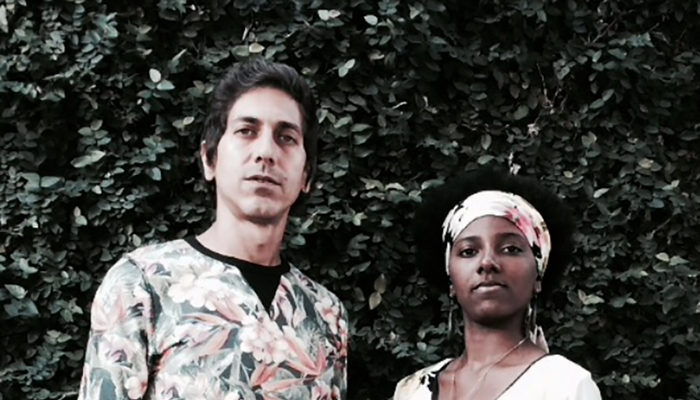
By José Gandue @Gandour
She was born in Buenaventura, overlooking the sea. He is from the city of Cúcuta, on the Colombian border with Venezuela. She comes from a strong Afro-Pacific musical tradition. He has been involved in the Colombian electronic music scene for several years through his project Posthuman. Now they, Eryen Korath and Arturo Brahim, together, under the name of Radiant, are part of the renewal of the Colombian electropical sound and have begun to attract the attention of local fans for their fresh compositions and striking live performances. Radiante is part of the lineup of Beautiful Noise Festival, which will take place between October 25th and 27th in Bogotá. For that reason, we sat down with Brahim to chat about the origin, present, and future of his band. Definitely a delightful story:
Let's begin, how would you describe Radiant right now?
Musically, it's a fusion of tropical electronica with Pacific folklore; personally, it's a story or film about
love, art and folklore with music as the narrator.
Love? That sounds interesting, especially in these times we live in. What kind of love?
One of those very romantic and intense stories, one of those in which everything is left behind to go after that love or that dream, which involved leaving the Andean cold to look for the right sounds and temperature in the Pacific Tropics following instinct, leading to the unknown and seeking to grow personally and artistically.
How has the transition been from making electronic music in the "first world" style to integrating local rhythms and sounds into compositions?
It was a necessary step, a need to explore my personal and musical roots. I always had a connection to the Pacific coast and to Cali through my family. I felt that pulse, that force that drew me there. By fusing indigenous rhythms, I felt I grew artistically once again. I undertook musical research that involved living and experiencing the local culture and engaging with local artists and festivals, which allowed me to find this new expression.
Where did Eryen Korath, his co-worker, come from?
It was precisely from that exploration. During the Cali Fair, there's a Pacific Day. There I saw her play and sing with her folk group, Cantares del Pacífico. I had in mind the sounds of the marimba, ancestral voices, the power of trumpets, and the rhythm of Cali's Afro-Colombian salsa. That implied an orchestra. But when I saw her on stage, I said, "That's the person we can do something with; she's all we need." She had magic. She plays the marimba and sings; she's the heir to a tradition. She's a natural talent. After her show, I approached her and told her I had some songs and ideas, and asked if she'd be okay with me sending them to her and seeing what she thought. And that's how this musical love story began. We've been working together for three years now. .
A question that might sound malicious: Isn't Radiante's approach part of the trend of exploring musical fusions that's been happening lately in the Colombian music scene? In other words, how authentic is their sound, and how much does it depend on current market trends?
I think it came at the right time. For me, it was natural, necessary. Colombian folklore has always been in my blood, and I grew up dancing and listening to tropical music. And of course, I was more than inspired by the first wave of fusion artists like El Bloque, Sidestepper, Chocquibtown, Vives, and Bomba Estéreo. They showed us the way. What I can say is that Ery didn't have that experience. She's very young, and Pacific Coast folklore is in her genes; that's why she's different and authentic.
How does this fusion sound to Ery's family and friends, who come from a traditional background?
That was part of the story; we had to build trust and get to know each other personally and musically before we started working together. I set up a small studio in Cali so we could work. In the first sessions, the
The whole gang—cousins, parents, and friends—were there, watching and listening. They realized this was well-structured and serious. Understandably so; Ery is a gem, and they take good care of her. But it's all been possible because we clicked musically. I've learned so much from her; she's a master. She also has her own folk group, studies law, and is a community leader. She really liked Radiante's sound, and we understood that by working together, we could take our fusion to new audiences.
What's next for Radiante?
The project was produced between 2016 and 2017, and we released it and made it public in 2018. Now we're promoting the album. Natural Cadence, We've only released two singles so far, and they've been well-received. We hope to tour, play festivals, make more music, and reach new audiences and territories.