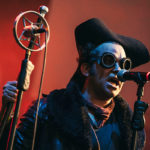
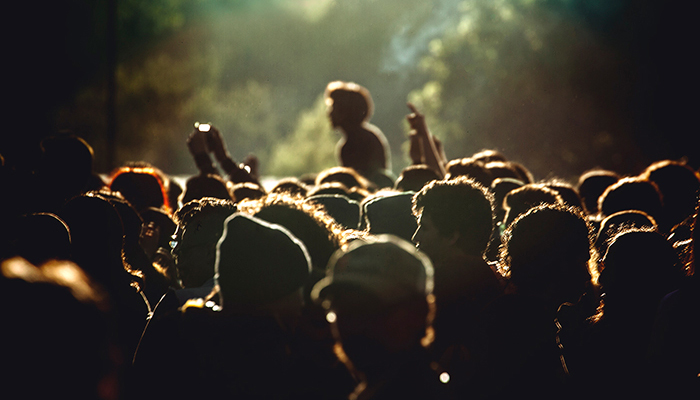
 By José Gandue @Gandour Photo by Oscar Perfer.
Just days before the twenty-second edition of Rock al Parque, we had the opportunity to interview Chucky Garcia, a prominent music journalist and cultural promoter, who, since 2014, He is responsible for scheduling the event. We talked with him about the particular characteristics of this new chapter of the festival, covering aspects of curation, the sound color of the concerts, budgets and other matters.
How would you describe Rock al Parque 2016?
Continuity with what has been done since 2014, inclusion of the festival's most representative audiences and the newest, closest ones; and a program that seeks to have these audiences circulate during the three days of the event. Once again, we sought to make the whole prevail. -the festival as a whole-.
What importance do you attribute to Rock al Parque within the cultural context of Bogotá and Latin America in general?
Last week, regarding the announcement of the Lollapalooza Colombia festival lineup, I read many comments from people in the industry and from the general public who expressed that This festival, and all others, had to be supported as a gesture of support for culture. And I was left thinking precisely about that fine line between festivals as entertainment and as cultural expressions. Or whether they're a mix of both, and if one excuses the other: that is, if people don't want to go because they don't like the bands, then they're disobeying the culture or the "cultural call." Regarding Rock al Parque, it's a high-impact metropolitan event that Through a musical offering, it seeks to encourage people to take ownership of a space and see the bands that play. From my point of view, it's as simple as that. As for Latin America, the festival invites bands from other countries in the region. And that's it. That's all.
What do you think would happen if Rock al Parque were to suddenly end?
That's a very good question. It's possible we've been at this for many years. going around in circles about the same discussion or debate. Sometimes I think many of the festival's detractors are like those little dogs that circle their sleeping spot a hundred times before going to bed, and then suddenly just lie down and that's it. And a year later, when the festival announces its lineup, they get up and circle it again a hundred times. And in conclusion, they're still in the same situation. I say this with affection and respect, and I include myself, because I too have pondered this same issue countless times. The difference is that, since becoming the festival programmer two years ago, I have the advantage of firsthand knowledge of the internal processes and the reasons behind many decisions regarding the lineup, for example. In conclusion, and to avoid digressing further, It would be like removing what generates the gravitational force of a universe or, in this case, a musical scene. And from a debate that has lasted 22 years and counting.
Let's talk about this particular edition. Don't you feel it's a bit too metal? I mean, it's the first time in 22 editions that the artists closing the Plaza stage all three days are legends of the genre.
No, I don't feel it's metal. And I don't feel it's metal because it's also the first time a band like Banda Conmoción will be performing, or the first time Puerto Candelaria will be there., Or is this the first time that there will be punk on the main stage on the closing day?, or because it's the first time there will be a stage for female alternative music artists.
But somehow it seems that, since one of the goals is to attract the largest possible crowd, the organizers are relying primarily on metal artists. Don't you think?
The goal isn't to attract the largest possible crowd. And the organization's confidence is placed in all the artists at the festival. Not just metal ones. When we say "to summon as many people as possible" it means limiting an entire curatorial effort to a single reason. And that's not the case.
We've seen a substantial reduction in the number of bands and artists participating in the festival through the district call for submissions. This year, only 19 groups qualified. Don't you feel that this somewhat affects the concept the event has always had?
As a programmer and artistic advisor directly I have nothing to do with the district call for applications. However, if I witness the auditions that take place behind closed doors before the jury appointed by the festival organization, and I know that if the jury considers that instead of 19 bands - for example - 25 should pass because there is definitely a lot to choose from; well, simply then 25 pass and not 19. Now then: this year there are 61 bands in total, of which 27 are from the district (4 invited, 4 from the alliance between Idartes and the metal table and 19 from the open call). So we're talking about district gangs being almost the 50% of the cartel.
Well, it's generally noticeable that the lineup has been reduced quite a bit, and it's clear they had a much smaller budget than in previous years. What kind of juggling act did they have to pull to put together this year's list of artists?
We worked with a smaller budget than in the previous two years, but at the same time, if you review the festival's budget history—or the budgets of editions prior to 2014— It's a prominent budget. But yes, there was a reduction. More than juggling, we had to perform a very mathematical and judicious exercise in terms of How much money did we have for each member of the cartel?, for each day and for each stage; which in any case turned out to be good because we undoubtedly ended up making a very balanced festival in terms of hiring. There is no huge difference in how much an international band is paid versus a national band, for example. I fully understand that highlighting positive things within something that people see as negative is not easy, but when you work in an economically challenging context, you learn to make the most of things.
If the festival's budget has been reduced overall (as well as that of other cultural activities organized by Idartes), why not consider expanding artistic exchanges with other institutions on the continent? This could complement the financial gains, couldn't it?
It's not that easy. At first glance, it may seem like a job that brings positive things, As you rightly mention, in economic terms, for example; but when you have a limited quota for international artists (whether Anglo or Latin) you have a limited number of options and you must play them as you should (or as you see fit). If you only have 6 bullets in the cylinder of your revolver, you have to try to make every shot hit the target. In the case of exchanges, and following the previous analogy, let me give you this example: Imagine you have to program the Plaza stage on Monday, which is the closing day and the day that likely draws the biggest crowd. So, if you have a stage in front of you that could potentially attract more than 80,000 spectators, and you have to choose between filling the cylinder of the revolver with 6 exchange bands or 6 bands that are much better known and have a much longer track record; What would I do? Undoubtedly, one would go for the second option. And not necessarily because their goal is to fill the park. As a programmer, whether the organizers ask it or not, you will always want the park to be full.
But the exchange groups would not be meant to replace, but to complement…
Agreed. They could be a very good complement. But then the question should be posed to the people who attend the festival, and not to the programmer. Do you want to see exchange bands, emerging bands, bands that have super interesting formats and sounds? Or do they want to see the bands that have been with them for most of their lives? Do they want to take a risk? Are they willing to step outside their comfort zone and venture out to discover new things that might change their lives? After 22 years of life, Is the Rock al Parque festival willing to change its image from head to toe? Because simply complementing what's already there could also become lukewarm, what about a radical change? It's a question we should all answer for ourselves before asking it of the festival itself, regardless of who its curator is or which administration is responsible for putting it on.
But then what you're saying is that the festival, in its current stance, prefers to be conservative and play it safe…
What I'm saying is that the festival, in any case, is not the programmer. The festival is the people themselves. It's the community that surrounds and supports him. And the programmer's work, anyway. It's about interpreting that, observing and understanding the nature of a festival that is not private. And it has had very conservative characteristics for many years. Not just recently. "Playing it safe" would be like saying there's no effort to take risks, to go off the beaten path, to break lines, rebuild them, try one thing and then another; to bring in bands that no one else would dare to bring. And that's not the case: in these three editions, at least, we have done it, and before that, too. And not just once, but many times. There are plenty of examples. For me, in fact, the work of programming and curation is more about observing than imposing. More horizontal than vertical.
Finally: As a spectator, not as a programmer, which artists are you most excited about at Rock al Parque 2016?
Easy Easy, Deafheaven, Baroness, Banda Conmoción, Decapitated, The Black Dahlia Murder, Sepultura and the female component that the festival will have this year. Oh, and Las Manos de Filippi. I think they're a very political band. And I've always admired what they do.
[metaslider id=813]