
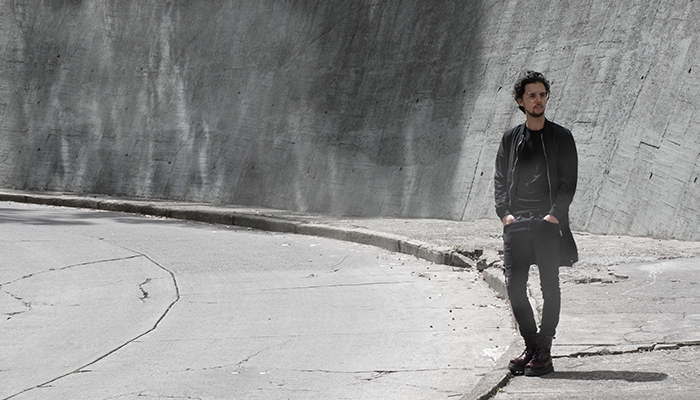
By José Gandue @Gandour Photos from the Samuel Lizarralde Archive
Colombian electronic music is finding new nuances to move forward. A good part of the catalog of its most outstanding artists has shone for some years now with its experimentation with evident examples of folklore from the country's coasts, And, as we listen, As this decade draws to a close, the mergers lab is becoming more subtle and, dare we say, more elegant.. These new generations of musicians are achieving greater recognition among specialized critics and enjoying the acceptance of an audience that seeks a more experimental approach and more glamorous textures in their performances. Clear examples of this are... Moügli y Böjo. In the first case (Moügli), It is the joint work of Juan Pablo Delgado and Samuel Lizarralde, with a strong presence in local alternative media and an interesting international projection. Böjo is Lizarralde's solo project, which has been gaining momentum and notoriety, especially since the release of a remix he made with the song Solari Yacumenza, from the Argentinian/Uruguayan group Underworld. This event has given us the opportunity to talk with Lizarralde about his work and what's next:
Tell me briefly what your musical story is.
Summarizing it is difficult, but I think it all started in my childhood. My father is an incredible music lover with very unusual and rather broad tastes. I grew up listening to everything from Pink Floyd to Brahms, including Julio Jaramillo and others. I decided to study music, and I think it's fair to say I proved I wasn't so bad after all when, in 2013, without having graduated, I managed to create the opening theme for a Caracol and Warner Channel series called Perfect Lies, where Manuel Medrano sang. From then on, I started composing a lot of music for television and film. Film has always been my greatest passion, aside from music. I received a scholarship to the USA and went to study music production. Upon returning, I founded Móügli with Juan Pablo Delgado, as an excuse to explore and fall in love with the country where I was born and which has given me so much. And now Böjo is born. It's actually been in the making for many years, but now I have the desire and the need to show the world a side of me that I hadn't explored before. A more personal side.
What does Böjo allow you to do that Moügli can't?
Breaking the mold, going musically and conceptually crazy. I've always been a bit of a rebel in my view of music and the world, and with Moügli, for various reasons, that rebellion was somewhat held back. Böjo is about being who you are without any fear. Without worrying about what others will say. It's something that will become clearer over the next few months with the project. I think that, like everyone, you start to break free from those paradigms little by little, so, like anyone else, Böjo will increasingly reveal those traits.
How would you describe each project in musical terms?
In short, Moügli is tenderness and magic; it's a picturesque, symmetrical magical realism. Böjo is dark but inspiring; it's a call to be free and to understand that the only source of love and inspiration you need is yourself.
What you're saying sounds like a creative battle of two demons, so to speak.
You could say so, Moügli feeds on the world and the senses, on what we perceive; that is its raison d'être. It is a tribute to nature, to cultures, to everything that surrounds us. Böjo is the complete opposite. It is a tribute to who you are as a person. It feeds from within, seeking to help each person lose the fear of being who they want to be. Sometimes it is easier to appreciate the world than to appreciate yourself. Sometimes rebellion against the world is born from a totalitarian acceptance of who we are.
Regarding your remix of the Bajofondo track, I have several questions. The first, perhaps the most obvious, is how did you contact them and why do you think they agreed?
It's an interesting topic, even though it might seem trivial; it's quite magical. To this day, I don't understand how they accepted it or why it appealed to them. It's the first remix of their new era, and I know there was a huge amount of interest. I think there comes a point where you have to let yourself be guided by your feelings or intuition. And for some reason, I felt I had to do something with them. I messaged them on Instagram, and they responded instantly.
It's one of those moments when you ask the world if you're doing the right thing, and in some strange way, it answers you. I believe we all have the ability to change our reality and shape it, to understand that our desires and emotions are sometimes stronger than we think, and that when we listen to them, things simply happen, as if by magic.
How do you approach remixing a song that didn't originally belong to you?
I think it boils down to two things: understanding and trying to feel what the original artist felt when they created it. And, most importantly, making it your own, making it yours, because only then can you give it a new, fresh, and different touch. Then you just have to hope the original artist likes what you've done, but it's about being sincere and giving it your all. track What you, in your essence, can contribute. It's like being put in charge of someone else's child and wanting to contribute something. The more honest and sincere that contribution is, the more it will benefit them.
What was their reaction to the final result?
Very positive, they approved it instantly. They only asked me to turn up Gustavo's (Santaolalla) voice a little when he talks about music and electronics, that was the only thing. Otherwise, they liked it a lot.
What are Böjo's plans from now on?
I wanted to release these three songs—two collaborations and a remix—to give a small taste of what Böjo is going to be. A little sketch of what's to come. From here on out, things are going to be a bit more impactful. It's a process to find yourself and go out into the world with a smile, simply because you know who you are and love that. These songs that came out are that spark that makes you react and calls you to change. What's coming is that change.
Much more radical and forceful. Throughout my career, I've postponed releasing an album for quite some time, for fear that the timing wasn't right, knowing that nowadays an album is practically media suicide. Well, that's what's coming: a full album, and without fear.
Is there a live performance format for Böjo?
Yes, it will be released with the album. It's a format I'm still exploring, but it will undoubtedly be very different from anything I've done so far. I want to combine my passion for film, orchestral music, and electronic music on stage. For now, I'm experimenting. Today I'm performing at the Julio Mario Santodomingo Theater with the Philharmonic Orchestra, in a film concert where Böjo had a small role. It's still part of this process of searching and acceptance that will soon yield its final results.
Finally, how will Böjo and Moügli's activities be combined?
These are two very different projects that can coexist without any problem. Moügli continues on its path and Böjo will begin its own.