
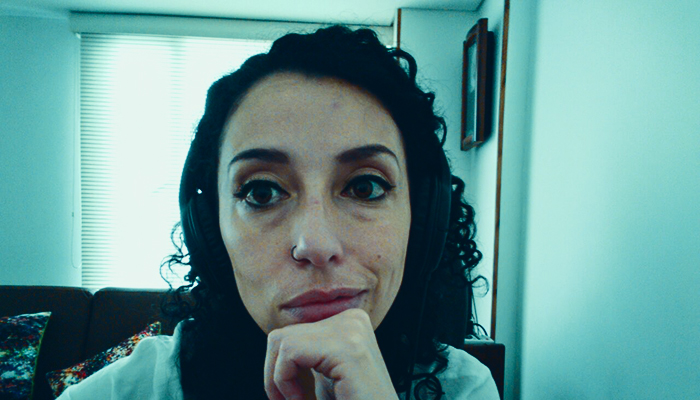
 By Ana González @brine.quoya
Editor's note: The specialized press and the Colombian public She is known as one of the best bass players on the scene. Her name is Ana González, and she has been part of prominent projects within Bogotá's alternative music scene, such as Mad Tree and Schutmaat Trio. Now, with her new solo project, she is recognized as Brina Quoya. We asked her to make a list of her current favorite music from her country, and she sent us a text explaining her choices. Here it is:
Oh'laville – Black magic: I really like the rhythmic/harmonic atmosphere of the song, which, through Afro elements, evokes a kind of ritual. I think they're easily the band with the best vocals on the entire national scene right now, and in this song, we can hear Mateo París go from very clean to very extreme places in his performance. I love Oh'laville because every time I see them live, there's something extra that never ceases to amaze me.
Mad Tree – Alchemy: This song came to me partly through Radiónica, and partly because, as fate would have it, I ended up playing it with them. I feel that even though they're not a Progressive Rock band, the lyrics have a certain attitude, being full of symbols and different levels of language that allow the listener to connect with it on many levels, and that, I think, takes real guts these days and is worth its weight in gold. I also love the energy the song releases throughout its arrangement.
Six Pedestrians – Comes back: With Andrés Cardona and Juan Amaya being the phenomenal guitarists they are, Seis Peatones is a band conceived entirely for and by the guitar, and this time they don't disappoint. The guitar parts are meticulously crafted, from the sound to the melodic ideas themselves, but they also maintain a tremendous balance between that and songwriting, giving this track a raw, passionate ballad quality that I absolutely love.
Ana Salive – Broken Memory: I've seen her perform at several gigs in the homes of amazing musicians in Bogotá, singing her songs accompanied by her guitar, and I've been lucky enough to sing and play with her on several occasions. She not only has one of the most distinctive voices I know, but she's also a singer-songwriter with incredible talent. This song is one of my favorites because it speaks of oblivion from a female perspective that doesn't rely on a posturing of empowerment.
Damn it – Panas: The first thing to say is: What a tremendous animated video! Standing ovation for the folks at Muta Bor Studio for so convincingly blending the visuals with the music. This is a musical piece brimming with sounds from the traditional music of the eastern plains, like the cuatro, the maracas, and some cattle herding songs, accompanied by pads, beats, and the occasional glitch, all contributing to the song's development. I think what I love most is its respectful use of traditional elements, avoiding the clichés of fusion, resulting in a very understated and beautiful sound.
Maria Vanedi – Brother (Richard Blair Remix): This song, in its original version, appears on the album Paz de María, which was also produced by Teto Ocampo. I feel it's an invitation to rethink our identity, recognizing that, in addition to Western thought, Indigenous and Black thought, along with their cultural expressions, have been just as, if not more, civilizing than what we in our Latin American culture consider them to be. It's an invitation to recognize each other as equals. What I love about this version is the way the vocals are used to create atmosphere, the bass pad full of sub-bass, and the Afrobeat-inspired groove.
Sidestepper – Magangué: I think Sidestepper's success lies not in using traditional music, but in their extremely careful use of it, avoiding the overuse and abuse of the "exotic." What I like most about this song is that it sounds incredibly traditional, and when you pay attention to the instrumentation and the lyrics, you realize that, like everything on this continent, it's steeped in many roots. From the colloquial "sí o qué?" so common in the cities of this country, to the chonta marimba, the flutes, and the call-and-response nature of the choruses; we are a melting pot of many roots.
Stereo pump – Hurts: Nothing to be done: This song first caught my eye with the giant tomatoes in a desert. It's a very unique video, and a very honest way of talking about grief after a breakup. The melodic part with the millo flute is particularly interesting and creates a perfect hook.
Lianna – I'm staying here: It reminds me of the Neo-soul and Hip hop sound from the late '90s to early 2000s, with artists like Erykah Badu and Lauryn Hill, and I think it's a great place for popular music to be. Electric piano with a very soulful progression and a vocal performance very much in that style. "Me quedo aquí" is an ode to feeling good about yourself and living in the present.
Schutmaat Trio – The hours: This song is part of EP 4, Schutmaat Trio's third release, and I like it because it's one of the songs that marked a step forward, moving away from their comfort zone. This comfort zone, in a way, was having found a sound categorized as alternative, which generated a lot of buzz in the independent scene between 2013 and 2015. They embraced other styles and ways of producing music. It has a lot of trip-hop influence, and that kind of... weird which always characterized the trio, and a somewhat existentialist stance in the text.
Brina Quoya – What you see is not me: It's part of the first EP of my personal project, which was released two weeks ago. It represents embracing the unknown of being part of a project from a very different perspective, and it's a song about change, about how difficult it is to remain in one place when life fills you with experiences that reaffirm certain things but also change others. This song was produced by Alvin Schutmaat, composed by me, and is now available on digital platforms for all of you.