By José Gandue @Gandour Renata Flores archive photos
Modernity belongs to us too. And yes, it seems ridiculous to say this sitting in the global village that is the internet, with our headphones on so as not to get distracted. and knowing within seconds what has happened in New York, London or Tokyo. But from our perspective, from our continent, where we burst forth every day with the flower of creativity and cultural innovation that is recognized and admired in other corners of the world, We think we're secondary, that those in what they call the first world always deserve more. We still have media personalities, some very well-known and prestigious, who are ashamed of what's around them, while they boast about what they once saw on their trips to Europe or the United States, saying things like «"Now that's cutting-edge," "They really know what they're talking about over there."». We are in lands where we still call someone who behaves badly and has rude manners a "rude man." «"Indian", "Cholo", and where some still believe that beauty should be blonde and blue-eyed. We still speak in colonialist terms, and music is no exception.
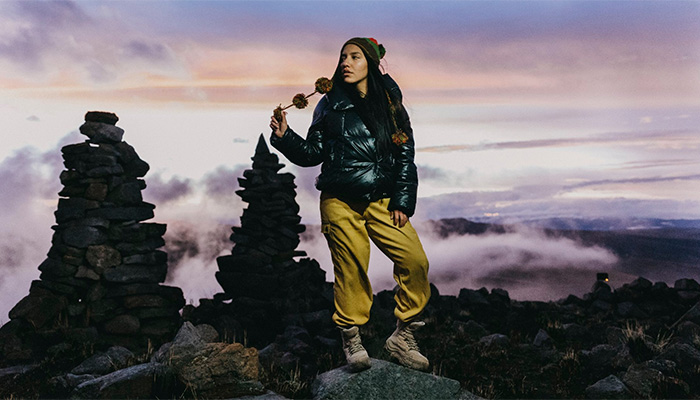
Renata Flores She is a beautiful girl who lives in Ayacucho, in southern Peru, and that he has decided to make pop, trap and hip hop in his native language, Quechua. And the result is wonderful, but not for exotic reasons. We didn't talk to her because of the curious fact («"Oh look, this young woman who decided to make songs in her own language, how extravagant!"»), but because he does it very well, His songs are seductive, pleasing, and on par with any similar offering from anywhere in the world. His videos are exquisitely crafted, where he takes the opportunity to showcase details of his culture's pride through brilliant photography and fine editing. His work has been featured on some of the most prestigious channels and radio stations in the global alternative scene, and yet his career has not been fully recognized in these parts.
We located Renata at her home, and took the opportunity to discuss these and other details of her career:
When did you start singing?
I started singing when I was little, around 6 years old.
And what did you sing back then?
She sang songs by Juan Diego Torres, Green Day, and Michael Jackson. That's what I remember.
When did you start making your own songs?
At 16, I finished school and wanted to continue singing and making music. One day I tried creating melodies on the piano, and little by little I developed a structure with piano melodies and my voice that I really liked, and we decided it would be my first album. single.
Was it a song made in Quechua?
I composed it in Spanish, but then we translated it into Quechua.
What was the reason for making that translation?
One of the reasons is that I didn't want to stop singing in Quechua, because I felt I had committed to rescuing it in some way, in this case through what I'm passionate about: music and singing. I felt I had a responsibility to bring Quechua to many more people; but the audience we wanted to reach was my generation.
For someone like me who doesn't know how to speak Quechua, how would you explain the beauty and importance of your language?
Through music, lyrics, and the sweet sound of Quechua, the visual aspect also contributes to the grandeur of our ancestors and how their legacy remains vibrant today, adapting to new eras. Quechua conveys a way of life, an ancient culture now recognized as one of the Seven Wonders of the World, and many more yet to be fully discovered.
How do you think your music reaches someone who doesn't initially understand your lyrics?
The native and traditional melodies of the Andes. And the visual aspect is also important, which is why we put so much effort into showcasing our culture.
What do you think your music sounds like?
It sounds like my roots and it sounds like the cry of the people who live in the Andes
And it still manages to be pop, right?
Yeah.
What do you aspire to now and in the future?
I aspire to make my culture visible and pave the way for many more artists who are also trying to reclaim their culture.
Finally, you have managed to gain recognition in very prestigious international spaces and media outlets, but not so much in Peruvian media itself. What do you think is the reason for this phenomenon?
I think it's because we've been made to believe that what's from outside is better and that the Quechua language is second-rate. On the most popular urban music radio stations in my country, they don't play my music. The same thing happens with other very good musicians who make rock in Quechua, rap in Quechua; we are going against the grain but always resisting.