
By José Gandue @Gandour
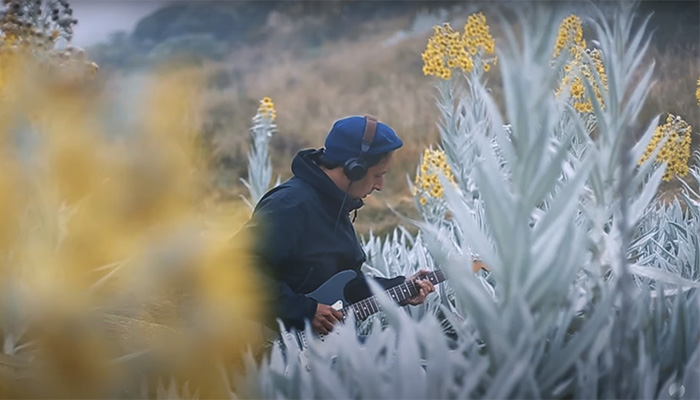
I met him when he had very long hair, playing guitar in a soundtrack. grunge, He soon recorded his only album and became one of the most celebrated rock acts of his time. He was only 18 years old at the time. And, without exaggeration, he was one of the best performers of his instrument in Bogotá. Shortly after, the group disbanded, and each of its members pursued other avenues of cultural and artistic expression. Miguel Navas, our subject on this occasion, discovered his interest in electronic music, and under the name of Savan, has released multiple recordings with various international labels, in which he has delved into experimentation with native sounds from the Sierra Nevada or the Amazon, among other local regions. For quite some time now, he has resided in the department of Quindío, in the heart of coffee country, amidst one of the most beautiful landscapes the human eye can behold (this is not exaggeration, it is an undeniable fact). That is where his headquarters are located. Latintronics, his sound laboratory Made to connect ancestral music with contemporary expressions. From that location, Savan's latest work, called Cocora, A five-track album that pays tribute to the mountains of the valley of the same name. Following the release of this material, we arranged to speak with the artist about his current life in the heart of Colombia's central mountain range.
It's been a long time since the rock 'n' roll days, hasn't it? Is there anything left of those times?
Yes, many years have passed, but the desire to express myself through music and sound remains. Genres are very appealing and help us agree on certain structures and forms, but music is much freer than genres.
What is music at this moment in your life?
For me, music remains a quest, a quest in which I want to find a way to serve people, but it's difficult because we musicians grew up believing that if we made so-called "Good Music," society would turn us into stars and we would be fulfilled. We spend our time chasing this phantom that keeps us from our peace of mind. The stories of many of our favorite musicians remind us that, although they have managed to contribute a great deal to people's lives, they don't manage to be functional or fully fulfilled, so there's something strange about this equation. A composition professor at university taught us a lot in this regard; as musicians, we have to rise above that pseudo-romantic madness and be capable of managing our lives and our work as musicians. Of course, artists in general have that passion that characterizes us, and I think that's not a bad thing. But we have to learn to detach ourselves from that passion in a certain way. So, it's also a goal to contribute more music to the vast sonic landscape of all human music.
At what point does the desire to learn about and experiment with ancestral sounds arise?
I think it stemmed from my work with documentaries, and more specifically with a sound installation called The Origin of Night, From 4 Directions. Where they asked me to help with the composition and specialization of the sound piece. For this project, the Murui, Andoque, and Barazano elders came, along with a Mamo from the Sierra Nevada and his wife, among others. We were able to record countless songs, myths, and ceremonies involving mambe and peyote. After this experience, which lasted several months, and to this day, these songs have become a musical root for me. I listen to them often and I hope they are influencing me. It's also important to mention that Native American music has been greatly influenced by blues, rock, cumbia, and other genres, and this influence is often overlooked.
What is there in your current location that you can't find in Bogotá?
I miss Bogotá, the music scene, and my friends. But Bogotá really knocked me out of my life in a way. It was a tough year; I lost my job, there were no gigs, and I couldn't pay the rent. My son was about to start school, and in Bogotá, that was unthinkable! So we came to Armenia, and here I've been able to get back on my feet. Before, in Bogotá, I had a space; I could play, experiment with strange ideas, but for the last few years, the city has become musically closed off. Ironically, this is precisely when there are more concerts by established musicians from all over the world. So I think on one hand, it gained in culture, but on the other hand, it lost a lot of its charm! I must say that Medellín and other places like Tayrona National Park, on the contrary, have developed a more favorable environment for local musicians to play. So, it's a trade-off!
Let's talk about your latest work, what's it about? Cocora?
Cocora It's a compilation that came about very spontaneously here in Armenia, amidst these mountains. From my studio, I can sometimes see the snow-capped peak, and I really love the energy of the mountains. So it's a bit of an influence from this environment, and a way of paying a small tribute. I think Indigenous people have a great advantage over us in that respect; they recognize life in the land, the mountains, and the rivers. How much can this knowledge help us right now? I'm glad that many artists and musicians are working around this idea.
What's coming in the future?
I can't say for sure, but I hope I can continue to grow and learn!