
By José Gandue @Gandour
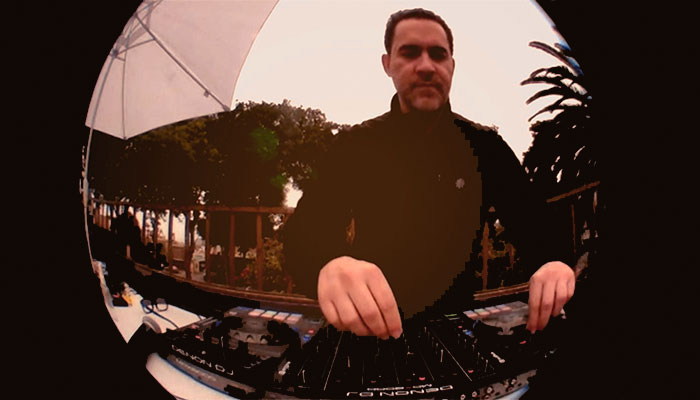
The pandemic has given our friend José Gallo time to reflect on his musical work. He has been performing for over two decades under the name of Theremyn 4, Developing his musical proposal, tied to electronic music, from Lima, his city, and during times of lockdown and quarantine, has been able to return to his earlier recording projects, seeking ways to recover them and make them available again to their former audience and to a potential new audience, transforming them into pieces of current relevance to be addressed in the current circumstances.
A few weeks ago Gallo released the new version of his double album My Life in Infrared, A compilation of 22 tracks that nearly reaches two hours in length. Throughout this production, we can observe moments of elegant construction with textures of traditional techno that could have been made anywhere else in the world, but also, brilliant moments of fusion of local sounds with contemporary instrumentation that are well worth the effort to be listened to and celebrated. To understand his work more deeply, we contacted the artist to interview him and learn about the process of recovering electronic memory:
Why are you recovering your album? Life in Infrared, Twenty years later?
It was several things: The first, I think, was this trend of "recovering" things during the pandemic. I did it last year with my first album. Fluorescent green in the yard.The 20th anniversary of both albums is an interesting milestone. Both albums were like something I'd been meaning to get around to, since they were released in very DIY versions on CD-Rs and photocopies. I owed them a proper edition.
Twenty years later, how did you feel the original material had aged and what did you feel needed to be modernized?
The first step was mastering, which is one of the things that was done on disc 1. I also felt that several of the tracks were a bit "flat," and as part of the process, I tried a series of reverb effects. Several of the songs are reworked on disc 2 of the album; it was something I'd wanted to do for a while. My life in infrared It's a kind of «"Work in progress"«", fragments of these long sessions of jammin To compose the music for Park-O-Bahn, which took a total of 6 hours. I could edit another one. My life in infrared parallel with other sections of jammin But that would be too much... haha
Let's put things in context for people, what was Park-O-Bahn?
The full name is «Modular 12°06´S 77°01´W Park-o-Bahn». It was a sound installation held in Miraflores Central Park in Lima, where more than 15 electronic artists filled the park with music and sounds for 168 consecutive hours. This took place in May 2001. The original cover of My life in infrared It has photos of the park and the speakers that were set up. In fact, I found those speakers iconic, so I used them for the artwork of the new album.
I ask you, what differences do you feel there are between the audience that lived that experience back then, and the new generations that are facing a review of your material in 2021?
Several of those who participated in Park-O-Bahn were part of a first generation of Peruvian musicians who used more software than hardware. There was a lot of experimentation during those 168 hours, and that was something new for young people and adults in Lima. I remember sitting in the park one afternoon that week with Carlos from 5 Esquinas (with whom I founded 1001 Records in 2000). We were observing people and their reactions, and some were annoyed because someone had glitched a bolero or added a sequence over it. Now everyone, or almost everyone, is more used to hearing that kind of thing. In fact, "fusion" electronic music is booming right now.
Did you find it difficult to accept that type of merger at the time?
No, not at all. In fact, with 1001 Records we were looking to create fusion-style music as part of the label's aesthetic. You can hear things like «"Chambi"» in it Fluorescent green in the yard o «"Apu"» y «"I visited the AM"» in My life in infrared and several songs on 5 Esquinas' debut album. That same year, a few months later, he released Inkaterra Coffee by Miki González and it was a hit.
What do you think happened that made the public, some time later, accept that merger?
It was a combination of things. During the first decade of the 2000s, there was a very strong campaign promoting Peruvian cuisine, and I think that had an impact on the revaluation of other aspects of Peruvian culture. If listening to huayno or chicha wasn't "cool" in the '80s and '90s, well, that started to change in the 2000s. Then began the whole movement of revaluing and rediscovering cumbia, chicha, and Afro-Peruvian culture. Look, so there's no misunderstanding... it was revalued for the mainstream.
Do these mergers have a chance of being appreciated by a popular audience?
«"Popular" can be confusing in Peru. But to be specific: if a contemporary electronic fusion group plays in any city in Peru, people generally understand and appreciate it. Now, there are also smaller audiences that understand fusion on another level, for example, more experimental fusions. Theremyn_4 doesn't play electronic fusion, but the audience reception during their 2019 tour was impressive. Lost & Remixed At the national level it was very good, better than in other years.
Now that this entire recovery and reconstruction process is complete, what's next for Theremyn 4?
We're already working on a new album, and we'll probably release a single by the end of the year, followed by the full album in 2022. Also, since concerts are starting to resume, it'll be great to be able to present material from these two anniversary albums.
What will the Theremyn 4 of the near future sound like?
To put it in pictures, imagine a '69 Mustang Shelby, but when you get in there's an iPad as a console, the engine starts with a retina scan, and you ask Siri to play a RATT album.