
By José Gandue @Gandour
The release of the live session by the Lima-born artist Dafne Castañeda for Catenary Discs, His record label gives me an excuse to tell you a story that will attempt to debunk, once again, the clichés surrounding nationalities, races, colors, or religions that get into our heads and then, every time these preconceptions, almost always negative, surface, they justify a number of stupidities that invade us for a long time. During the nineties and part of the beginning of the new millennium, The image that Peru had in many Latin American countries was that of a backward territory, unfortunately ridiculous, all due to the proliferation of satellite dishes that populated our neighborhoods (before the formal arrival of cable companies) And through them, one could see almost all the channels broadcasting from that country. It was trash television, whose deplorable dynamic was based on the constant humiliation of those who naively appeared on camera. Many viewers remember the horrific and degrading work of Laura Bozzo., A scandalous presenter willing to profit from human misery by any means necessary. Such was her impact that many thought Peru was a squalid quagmire, both economically and aesthetically. Because of the satellite expansion of its telecommunications industry, many didn't believe anything decent could possibly emerge from Lima and its surrounding areas in the arts. Those prejudices still linger in some people., But the quality and originality of a large part of its contemporary cultural proposals are currently disproving that unfortunate image day by day.
For some time now we have been emphasizing this at Zonagirante.com, both in our editorials and in our private conversations with some of our friends, The Peruvian music scene, especially the female segment, is growing and should be taken into account by the rest of the continent. We are talking about a space that, despite not having any support from the major channels, not being played on commercial radio stations, and having little coverage in the most important newspapers, The richness and variety of the independent productions published there are worthy of being promoted. In this context, we can name potential pop stars such as Naïa Valdez, Nuria Saba, Micaela Salaverry (among many others), and if we go to the more alternative paths, we find our admired La Zorra Zapata, Ati Lane, Aura Blum, the Dan Dan Dero girls, Flamenco Plástico, etc. And this is where we have to mention our protagonist today. We met Dafne Castañeda through her beautiful Postwar period. an album of seven songs with an eclectic sound, a blend of folk, trip hop, Andean waltz and techno, A flawless work in its intimacy, in the boldness of its construction, and in its breaking of formulas., with the most sincere intention of imprinting the most personal emotions on our hearts. It is not an exaggeration when we say that Postwar period It may be among the best albums we have heard in Latin America so far in the twenty-first century.
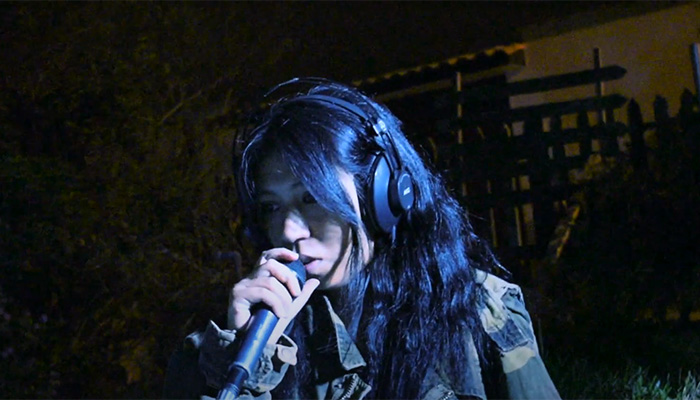
Dafne has now decided to treat us to a live session, recorded in an unexpected way. Without dazzling gimmicks, and almost like a private document, Using an empty, dimly lit swimming pool as a stage, and relying solely on his computer, a microphone, and appropriate sound effects for his voice, presents a set of three songs, Upwind, If anyone asks y Before birth. It's a show that feels more like a kind of confession, almost telling us «"I do this because it's what saves me, so there's no time to apologize if people are offended."». His, in this case, It's a Low Fi aesthetic. It works, it moves, it overwhelms. She's a credible artist; how many can say the same?
This is an eleven-minute video, and it's a low-budget production, yes, but it's worth sitting down, enjoying, and confirming, as I said before, that in Peru, in many ways, Women musicians of recent generations have much to say and are saying it, and their voices and instruments must be heard.