By José Gandue @Gandour Photos @Kvk_fotos
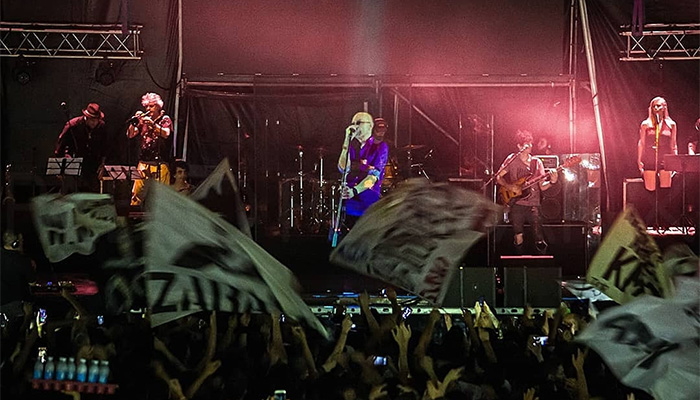
It was the last large-scale concert held before the nationwide quarantine was declared in Argentina. Tickets had been sold out for several weeks. The Air Conditioning Fundamentalists, band that has accompanied the Indio Solari In his final stage as a solo artist, he awaited his audience on March 7th and 8th at the Malvinas Argentinas Stadium in Buenos Aires with a surprise that was going to leave everyone stunned. In the middle of their set, they had a special guest, someone who hadn't been on stage since 2017, in the Buenos Aires town of Olavarría, in front of hundreds of thousands of fans. The one and only Indio, who confirmed a few years ago that he suffers from Parkinson's disease, He promoted his bandmates' performance through an announcement on his official social media, but in no way confirmed his own presence at the event. However, in the middle of Los Fundamentalistas' set, he appeared, and the audience's expressions of astonishment were complete. Indio, still confined to his home due to health issues, He sang three songs per show, two in hologram format and one projected on the large screen on the stage. How was this idea carried out? One of those responsible for this project, Marías Mera, from Crane Films, He told us the details of that process.
How did the idea of turning Indio Solari into a hologram come about?
It all started a while ago with Gaspar Benegas, one of the guitarists for Indio Solari and Los Fundamentalistas. The idea was to try and make Indio's presence as real as possible; we'd already thought of it even before the need for Los Fundamentalistas to play separately was raised. Indio can't do live performances for reasons he explained some time ago. We started to envision it when we did the concert to raise funds for Martín Carrizo, but we couldn't do enough; we only used the screens. So we coordinated it for the concerts on the 7th and 8th. We said, "This is the opportunity to do it." And from there, we started looking for the technical solution. We told the musicians about it, they liked the idea, and well, it finally came to fruition.
What was the process like?
The first step was to start thinking about the technical solution. The hologram works on a transparent screen, and it had to be done like a magic trick so no one could figure out how the format worked. We looked at different holograms, such as Maria Callas's or even Tupac's. We hadn't liked the 3D model of Maria Callas, so we tried to find a way around it. Then came recording Indio in his Luz Bola studio, recording some songs that were originally recorded for the show. Remember that Indio practically never leaves his house. Then came the tests, in different settings, initially in our office, then in a couple of clubs, and then at the dress rehearsal in the stadium. Indio's voice was pre-recorded on a separate track, in a unique process, while the images for the show were being recorded, with the band also present live.
Did the audience know about this "presence" before the concert?
No. The hardest part was precisely that: keeping everything secret. The process involved so many people: the musicians, the people at the venues where we did the soundcheck, the projector rental companies, the technical setup—in other words, a lot of people increased the possibility of a leak. And I think that was the most interesting thing. We managed to keep it from leaking into the "Indio world." Because he's so private and keeps everyone on their toes, anything, any piece of information that slips out, gets out instantly. I think one of our greatest achievements, beyond the polished image and the technical solution, was the secrecy we maintained.
What was the audience's reaction?
The audience reaction was very interesting, especially at the first show, where it was unclear whether there would be a stampede. Even if you look at the comments on the YouTube videos, you'll see that many people say «"I believed I was there"». People moved around thinking that Indio was really coming out. What was also interesting was that we managed to do it with songs from his latest album, which he had never played live before—the one that was released after Olavarría.
Given this result, how else could they implement this technique?
The future application of this technique is completely secret. In fact, we still don't have a clear plan. I've been thinking about what we could do to keep it original. We'll see how it goes. Today it's difficult to even imagine a live show, so, well, that will remain a secret for the future. The wonderful thing about what happened is that Indio anticipated a present-day reality for humanity, which is this virtual functioning of everything. Now it's likely that even the audience will be holographic at the shows.
Finally, as someone involved in the audiovisual world in general and the music scene in particular, with everything that is happening, what needs to be done to save the future of concerts?
Sit and wait. Today, any hypothesis of restructuring is more wishful thinking than reality.