By NTD.la Staff
(Editor's note: And yes, we're talking about soccer. We're die-hard fans of Latin American teams, and we love the great stories of the sport, the ones that reveal the heroes of the day, those who truly deserve monuments over the bloodthirsty conquerors of yesteryear, or the solemnity of the powerful who did nothing for their people. And we're not contradicting ourselves when we demand a gigantic statue in every town square honoring Diego Maradona, alongside images of admired figures like Willington Ortiz, Rubén Paz, Cholo Sotil, Sócrates, and Carlos Caszely, among many others, and, at the same time, we demand that the Copa América not be held in Colombian territory under any circumstances until the police repression stops. We want to celebrate, and that's why we're republishing this article from our friends at NTD.la and adding a playlist of songs from the continent, but we don't want the game to be tarnished. Are we clear?).
The Sportivo Barracas stadium is packed. The match against Uruguay kicked off a few minutes ago, and fans are still arriving. Nearly 40,000 people are crammed together to watch the derby. Uruguay are the favorites. They're coming off a victory at the Paris Olympics, marking the first time in history that the country has won a national championship. But today, October 2, 1924, in Barracas, the Olympian will be an Argentinian, Cesáreo Onzari, author of the first goal scored from the corner. At the beginning of the last century, international football was just beginning to shape its institutions. But the rivalry between Argentinians and Uruguayans was felt with full intensity since 1901; when they officially faced each other for the first time. Twenty-three years later, the situation had become very complicated.
On September 28, 1924, the two teams faced each other on the field of Sportivo Barracas. It was a rematch of the first leg in Montevideo, where they had drawn 1-1. Inaugurated four years earlier, the stadium located on Iriarte Street had a capacity for 37,000 people and was the place par excellence for important matches; the Monumental of the 1920s. But that day everything went haywire. Newspapers at the time claimed there were between 50,000 and 60,000 fans in the stands. Give or take a few minutes, the fact is that within minutes of kickoff, stones and bottles were flying everywhere. The match was suspended. Thus, for the resumption of the match – on October 2nd – the organizers fenced off the stands with wire., the “Olympic wire”, another of the historic innovations of that day.
The Uruguayans had just surprised Europe with their sophisticated style of play. The French—hosts of the 1924 Games—went from mockery to adoration; so much so that when Uruguay beat Switzerland in the final, the players circled the field, greeting the unexpected fans up close. They were taking the first victory lap in the history of football. That had happened in June. Now, a couple of months later, they were leaving a golden trail wherever they went.. Everything that happened with the champions was "Olympic". But the gold rush in Paris would also bring misfortunes.
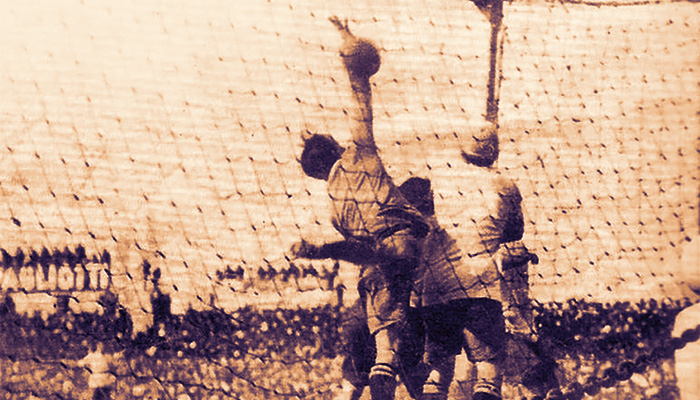
At 15 minutes into the first half, Argentina has a corner kick in their favor. The one in charge of the execution is the fast one wing left-back of Huracán, Cesáreo Onzari, 21 years old. Uruguayan goalkeeper Andrés Mazzali is alert to repel any header that threatens his goal. Onzari unleashes a furious left-footed shot. It's a very tight cross. And the ball closes in further, too much. It was too late for Mazzali, who, more focused on the opponents than the ball, watched from the ground as he conceded the first Olympic goal in football history. Strictly speaking, it was a goal against the Olympians, which later became known simply as an Olympic goal. Some say that Carlos Gardel was in the stands. The Uruguayans were stunned by the unexpected play. They protested to the referee, claiming the goalkeeper had been pushed and that the goal shouldn't have counted. It had only been four months since the International Board had changed the rules to allow a goal from a corner kick. In time, they would say that Onzari didn't intend to shoot, that it was an accidental error in the ball's curve. The Argentine always swore he aimed for the net.
The match ended 2-1 in favor of Argentina. Few remember the result. Even fewer remember the goalkeeper beaten by the striker's left-footed shot. Burner. Throughout his career, Onzari played 15 matches for the national team and scored, in addition to the historic goal, four other goals. He died in 1964, at the age of 60., wearing a medal more golden than gold.