
By Andy Flores – @andyfls
(Editor's note: We continue to rely on the archives of our colleagues and brothers at NTD.la to gather stories from our continent. This time, Haiti. Everything is explained in the article below. We've also included an incredible playlist featuring the brilliant current music scene from a country about which, shamelessly, the vast majority of the inhabitants of this continent know very little or nothing.).
Haiti is not talked about. And if it is done, it is to describe hurricanes, poverty, floods, or earthquakes. However, in that half of that island 211 years ago, the direct victims of colonization and slavery in America started a revolution that would change everything. The first republic in Latin America was born in Haiti., and the world's first black republic. A revolution admired and silenced.
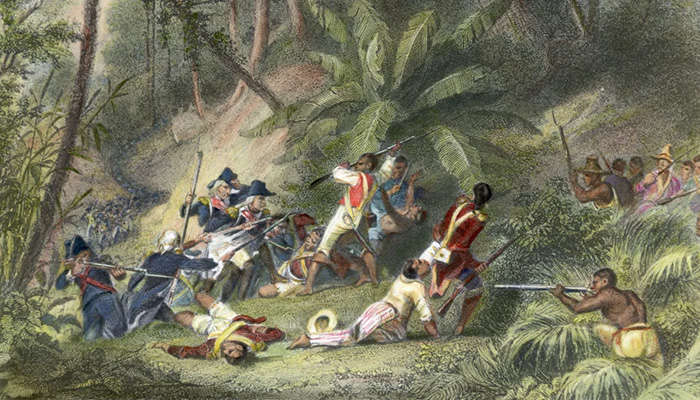
On August 14, 1791, enslaved Africans and people of African descent in the colony of Saint Domingue began the revolts that would lead, only 13 years later, to the triumph of the enslaved over the colonialists and slave owners. The thirteen years that passed between the start of the revolts and the final proclamation of independence were full of twists and turns that fluctuated according to the outcome of the battles, and above all, of the political ideas that arrived on the island from Europe.
By the 18th century, The French colony of Saint Domingue was the most productive in the Antilles. They were known as the "sugar islands," although they also produced coffee and cotton. In total, their production accounted for two-thirds of French colonial trade. and by 1789 its exports surpassed those of the fledgling United States.
The economic importance and the interests at stake explain the caution with which the half-island, which Spain had seized in 1665, was handled from Paris. From then on, the territory had been divided in two., one part Spanish and one part French. Its main city was called "The Paris of the Antilles." It had 10,000 plantations, hundreds of sugar mills, and 600,000 inhabitants, almost all of them slaves. In fact, it is estimated that 30,000 new slaves arrived each year. Such a large population and volume of production allowed 40,000 white Europeans to live a life of luxury. The social organization on the island was very clear and rigid. At the top of the pyramid, depending on their wealth, were the wealthy whites and the lesser whites. Below them were the mulattos, who could also be either large or small landowners. And at the bottom, the slaves.
Paris was a hotbed of political discussions and winds of change. In 1789 the French Revolution broke out and proclaimed: Liberty, equality and fraternity. The cries of the triumphant revolution reached the Antilles, more than 8,000 kilometers across the ocean. By the end of the 1700s, if there was one thing Saint Domingue lacked, it was freedom. The white population was unwilling to accept the new French government and wanted autonomy. Meanwhile, the mulatto population sought equality with the white population. The island was a ticking time bomb.
The mulattoes with property on the island begin the rebellion, not yet including the slaves. A mulatto leader emerges, Oge, a hope for victory. But Oge fails to achieve victory and flees to the Spanish side of the island. The Spanish, in solidarity with the French, deport him, and the whites execute him. The first rebellion is crushed. In 1791, the violence pent up by the slaves erupted again., Despite risking their lives to gain their freedom, they were always betrayed. In the clashes, 2,000 whites and 10,000 blacks died. The mulattos, many of them small and large landowners, formed an alliance with the slaves; the society took the name "Society of the Friends of the Blacks," and it maintained good contact with the revolutionary ideas in Paris. The alliance between mulattos and slaves is established, but it is not the only new development in those days. The Spanish, who govern the other half of the island, want to wrest the territory back from France and ally themselves with the mulattos and slaves. The mulattos achieve their first victory: the French revolutionary government grants them equality with whites. There was still nothing for the slaves.
The large white landowners, besieged on many fronts, find allies in the English. The situation overlaps a social revolution, an ethnic war, and the involvement of several republics.. The class-based and racial nature of the Haitian Revolution worried the ruling classes of Europe and united them against a common enemy.
In 1793 France finally decided to abolish slavery and the news also reached the small island in the Antilles. Toussaint L'Ouverture, a former servant who had now become the undisputed leader of the revolt, It establishes that from that moment on everyone will be wage earners instead of slaves. There will be years of internal wars, but without slavery or foreign soldiers.
Everything ends with Napoleon Bonaparte taking advantage of the prevailing peace in Europe, In 1802 he sent 24,000 soldiers to Saint Domingue to crush Toussaint. The equality that had flourished in the Antilles under the protection of revolutionary France was now being destroyed by Napoleon's France. Its effectiveness was absolute. Toussaint is captured and dies a prisoner in France.
The outlook on the island is grim. Slavery has returned, and the atmosphere is tense, but there's a sense that the situation can't continue like this for much longer. Many mulatto and Black leaders were skilled in warfare and are prepared to reclaim their freedom. Jean-Jacques Dessalines, who had already been a general, He was now at the forefront of the uprisings against the French troops that stood between him and achieving the end of slavery. Finally, on January 1, 1804, Dessalines proclaimed the independence of Haiti, and a year later the Constitution that It establishes that all Haitians, regardless of their color, will be called black. It thus became the first republic in Latin America, and the first Black republic in the world. At that moment, a new specter began to haunt America: the specter of the Black revolution.
The Haitian revolution, a black revolution. A revolution admired but silenced at the same time, for fear that the example would inspire the rest of the colonies.