
By the editorial team of Ntd.la
(Editor's note: We've found another incredible story in the archives of our friends at NTD.la, recounting the adventures of a wonderful character, whom we also wanted to honor with a playlist of 13 songs full of intoxicating elixir and great sound. Welcome!).
In the mid-1950s, radio and TV were vying for the market's presence Santiago Policastro, a son of Italian immigrants who had been born in 1911 in Buenos Aires and who carried the pompous title of World Cocktail Champion: A drink he named "The Duck" had earned him the title at the 1954 Swiss competition. The one himself Juan Domingo Perón He received him in his office and described him as "an Argentinian who serves his country."«.
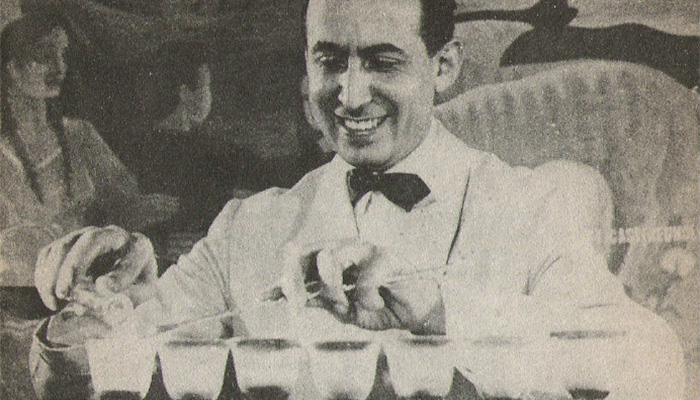
Policastro was a true celebrity of the local jet set. He owned several nightclubs in Buenos Aires and Mar del Plata, rubbed shoulders with film and music stars, and had appeared in the film Nightlife with Tato Bores, Olinda Bozán and Hugo del Carril. With his movie-star looks and refined manners, he earned the nickname "Gentleman Bartender." That's how he presented himself in Casino Phillip, the first entertainment program on Argentine TV that aired on Channel 7.
Although “Pichín” – as he called himself – wasn’t very interested in politics, had had the opportunity to travel the world with the then Minister of Foreign Trade, Antonio Cafiero, which organized a series of fairs in different countries to showcase Argentine industry. Pichín was there representing Argentine liqueurs.
According to the bartender himself in a letter, during one of these fairs in Germany he had to prepare themed cocktails for the representatives from Moscow: “I scoured half of London to find a metalwork shop that could make me a brass hammer and sickle, which I placed on an orange peel base so it would float on the red cocktail. When the Russians approached and saw the “Soviet” drink”, They loved it.”. Following this incident, the newspaper La Razón published an article highlighting that “"What Ambassador Delisi couldn't achieve through diplomacy, Pichín achieved with cocktails.".
Once back in Buenos Aires, Pichín received several calls from the Presidential Office. And although at first she thought it was some kind of joke, she finally agreed when the voice on the other end of the phone told her “The president wants to speak with you.”.
Policastro was nervous the day he met Juan Domingo Perón. She didn't know the reason for the appointment, and dozens of ideas of all kinds occupied her imagination. However, when he entered the office, Perón greeted him with a “My dear Pichín, I congratulate you… you are one of the Argentinians who build the nation!””And after chatting for a while, the president asked him what he needed to continue doing his job as he had been doing up to that point. Without hesitation, the bartender replied: “I need a boat.”.
The idea was quite ambitious: Traveling through America and reaching the United States, bringing Argentine drinks and wines in a joint initiative. In this way, the government would promote the trip, and businesses in the liquor and wine sector would contribute their products. At each stop, the Argentine embassy would organize a meeting with importers to showcase the various beverages from our country. And so it was done: in June 1955 he set off on a month-long journey along the Atlantic and Caribbean coasts of the continent, finally reaching New York. The initiative was a commercial success.
But upon returning to Buenos Aires, the coup had taken place and the so-called Liberating Revolution that had overthrown Perón accused him of being a "Peronist bartender". Although Policastro tried to respond that he had no ties whatsoever with the overthrown government, he was forced into exile, never to return to Argentina. He lived in Venezuela for several years and became the manager of the traditional Pampero Rum factory. Later, he founded several bartenders' associations, including those in Venezuela, Puerto Rico, and the Dominican Republic, solidifying his role as an internationally renowned bartender. Even today, the Pan-American Bartenders Award, organized by the international association that brings together regional bartenders, bears the name of Santiago Policastro.
Among his most famous creations, we must mention “The Clarito”, Clarito, a dry gin-based cocktail that held the top spot among national drinks for decades. Pichín himself claimed that with Clarito he had achieved “to interpret the palate of the Argentine drinker.”.
In 1950 he published “Magic Drinks”, a book that, in addition to containing recipes and opinions from famous people with whom Pichin rubbed shoulders, has a Decalogue of the Good Bartender:
I. The bartender is an artist and cocktail making is an art that thrives on spirit, flavor, aroma and color.
II. The bartender's mission is to cheer people up, not to intoxicate them.
III. Make the customer a friend, not the friend a customer.
IV. Never offer a drink without a smile.
V. Speak only when necessary, do not listen to what is irrelevant, and forget the confidences of your friend.
VI. Be the cleanest, the most elegant, the most cordial, the most refined, at all times and in all places.
VII. Don't cheat with the drinks or play with your friends' trust: always serve them the best.
VIII. Be patient with those who help you at the bar, teach them your trade with love. Don't deceive them.
IX. Keep professional solidarity alive and don't let anyone break it.
X. Be proud to be a bartender, but earn it.
Santiago “Pichín” Policastro, the so-called Gallant Bartender or Peronist Bartender, died in Miami in 2010., at 98 years old.