By Tomás Pont Vergés – @pontomaspont
Editor's Note: As has become customary in recent weeks, we've turned to NTD.la's archives to continue sharing the great and incredible stories of music from across the continent. This time, we return to Brazil and learn details about the life of a legend: Tim Maia.
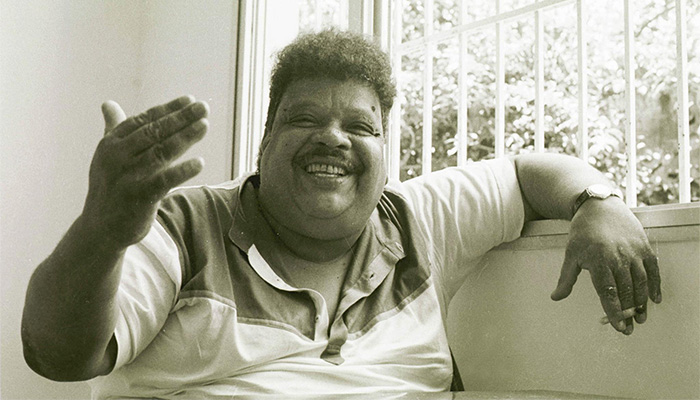
We all know the jazz-bossa that João Gilberto and Stan Getz invented in the early sixties. Unfortunately, in recent years we've also seen bossa n' Beatles, bossa n' Stones, bossa n' Marley, bossa n' Ramones, and other such monstrosities on the music scene. But few people know about Samba-Soul. And this is a truly authentic genre, a gem from Rio. It emerged in the seventies as the dark and rebellious counterpart to bossa nova, and spread through the labyrinthine corridors of the barrios, mutating, with their street dances and Afro-Brazilian activism in a massive social movement, which they called the "Black Rio". This genre, as is often the case, has a unique figure, a musical genius, a man who, in his boundless creativity, understood the sounds of Brazil and gave them a twist through soul music. The genius we're talking about was Sebastião Rodrigues Maia, better known as Tim Maia.
The chubby Sebastião Rodrigues Maia was born in 1942 in the chic neighborhood of Tijuca, where his parents worked in a boarding house. He is the 12th sibling in a family of 19. During his childhood in the 1950s in Tijuca, Tim made friends with well-to-do kids from the neighborhood like Erasmo Carlos and Roberto Carlos – who are not brothers – through football and a passion for it doo wop, that genre that The Platters sang. In 1957, together they formed "The Sputniks". Tim's childhood dream ended badly: he wanted to participate in a television program, but the host, upon seeing Roberto Carlos, invited him to sing solo the following week. Thus began the meteoric career of O Rei. And with it, Tim's resentment. While his childhood friends Erasmo and Roberto Carlos became teen stars, he – who was the musical brain- was outside of show business because he's fat, black, and poor.
Tim then set himself the goal of succeeding in the USA. At 17, he tricked his family into believing he had won a scholarship to study music in the US, saved up money, and went to New York alone. It was 1959. In the US, he learned to sing in English, immersed himself in the emerging soul music scene, formed several bands, which he disbanded in scandalous fights, worked as a dishwasher in every bar and club in the city, experimented with soft and hard drugs, and ended up involved with a car-stealing gang. By 1963, he was behind bars in a Florida prison. In 1964 he was deported to Brazil, after tearing off another prisoner's ear in a fight.
He returned to Brazil penniless and with a few vices, but above all, with a lot of music in his head. In 1971 he released his first album: Tim Maia. Seduced by his voice, Elis Regina mentored him from the beginning of his professional career and produced his first album. The album was an immediate hit. And Tim Maia became the beachhead of the Samba Soul invasion, the soundtrack of the underground Black Rio movement. However, Tim couldn't handle himself. He spent his days as a Samba Soul star drinking whiskey, trying every psychoactive substance he could get his hands on, and eating frenetically. Weighing in at 150 kilos of pure talent and alkaloids, he was a wild man. He bought jewelry that he threw to the audience during shows, attended meetings with record executives with mastiffs, and compulsively composed and recorded music only to burn the tapes afterward. Tim was paranoid, carried a gun everywhere, and suffered from strange phobias. For example, he had a phobia of bald waiters.
In 1974, in the middle of a mescaline trip, Someone brought him a book from a UFO sect called "Rational Culture" led by Master Manuel Jacinto Coelho. From one day to the next, he quit drugs and dedicated all his compositions to doctrine. He then published the two volumes of Tim Maia Rational, her magnum opus. But her “rational” experiment ended badly, very badly. One night Maia discovered caught red-handed He cheated on his wife with none other than Miguel Coelho, and his world collapsed. Once again. By the late seventies, he was back to drugs and bad habits. Sadly, he was back to disco music. But his legacy was already enormous.
Maia died living up to her myth. On March 15, 1998, she gave a recital in Niteroi, Rio's sister city located across Guanabara Bay. In the middle of a song, he collapsed on stage and fell dead. Tim Maia, a mix of Pomelo, Barry White, and spiritual leader new age, who with his voice, charisma and musical talent, changed the history of Brazilian music.