
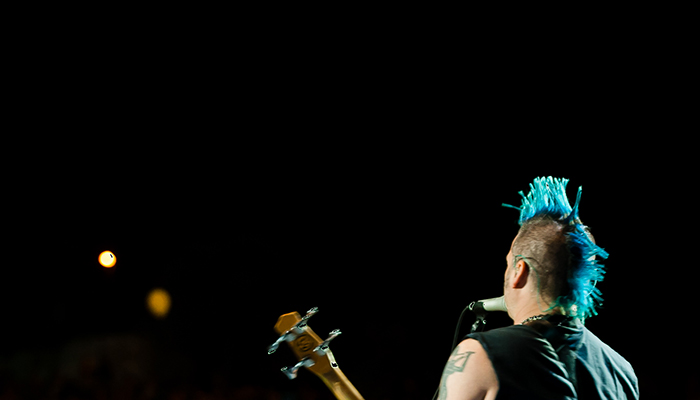
 By Santiago Rivas @rivas_santiago Photo: Rodrigo Morales @megapulse
Rock al Parque isn't what it used to be. Not only because everything changes (from Heraclitus to Mercedes Sosa and so on), but because It no longer represents the same thing for Bogotá as when it was created. The festival used to be the cradle of an interesting scene, the real support that the capital's rock scene needed to rise from total irrelevance to become a movement, thanks to this event, in which urban tribes, genres and music lovers in general could unite around the idea of belonging to something bigger than themselves. Rock al Parque ended up contributing to the development of rock music throughout the country.
I believe that the vast majority of those who read this website feel the same way we do, that Rock al Parque is important. Not only does it remain a crucial milestone in Bogota's cultural calendar and a landmark of the city, it is also the only way that the vast majority of the capital's inhabitants (and the entire country, with some effort) have to discover new music and see their favorite bands or experience a great concert, with musicians who are already part of the classics and the greatest. It's an opportunity to be surprised, and that in itself is quite something. But Peñalosa is in charge, so it's worth asking ourselves What if this was the last Rock al Parque?
Let's begin by speculating in an apocalyptic way: Peñalosa doesn't understand Rock al Parque. Or he understands it, but doesn't consider it important in the slightest. Numbers, as we've had the opportunity to appreciate, are useful for anything. Our current mayor (and the right wing in general) uses them to demonstrate that Rock al Parque (like culture in general) doesn't matter to anyone, as mainstream radio, current affairs magazines, the meager coverage in major newspapers, the entertainment industry, and even much of the young public seem to agree., who sees the festival as an unnecessary gathering of smelly people, so different from other concerts and other festivals. It's not the majority, but in these times of high connectivity, all opinions count, no matter how ignorant, irrelevant, uninformed, or malicious they may be.
The money Bogotá spends on its festival could be used for other things., they might think. And it could also be sold. They are already destroying Idartes, reducing its relevance, its presence in our lives (Have you noticed how the Idartes logo is appearing less and less on billboards, bus stops, newspaper ads, etc.?They're very likely downsizing too, but I have no way of proving it. The point is, culture in Bogotá can completely change course, regardless of the budget or the name it's given. Would the end of Rock al Parque mean the end of corruption in the city? I seriously doubt it.
Anything can be called culture, and if the gigantic budget they announced (to which they can no longer add the money that will be used for the new Cinematheque) is spent on printing billions of copies of Carreño's Etiquette, That can still be considered culture. It's not a good use of the budget, but the polarization (that is, the unnecessary and excessive ideological struggle that permeates every decision made in Bogotá and Colombia in general) justifies anything, apparently; even getting rid of Idartes, which has proven to be the best way to ensure that things happen in the district's cultural scene, without it counting for anything. the fact that it was created by left-wing governments.
But let's return to the question: What if this were the last Rock al Parque? And let's continue, while we're at it, with all the questions that might arise from this: Would anything happen at all? Would someone with more visibility than the average tweeter, the average metalhead, the average audience suffer? What role does Rock al Parque play in our lives, in the life of Bogotá? Would the music scene and market in Bogotá or Colombia change in any way if Rock al Parque were to end? Who is the festival really for?
Of course, none of these questions has a single answer. I believe that if this were the last Rock al Parque, The city would be betraying its youth and its history. Possibly nothing would happen, and the outrage wouldn't lead people to rise up against the District, as happened when Peñalosa himself wanted to end the festival back in the nineties. Perhaps the noise wouldn't transcend the invisible boundaries of social media, It wouldn't amount to more than a metalhead demonstration, or whatever.
I believe, however, that Rock al Parque plays a fundamental role in our lives, because it is a source of pride to live in the city that created this enormous festival for its young people, where so many excellent moments have taken place, where pleasant memories have been created for the vast majority, and where people have been able to gather in one place, without killing each other, to all the trends of a music considered violent and irrational. The scene may not change much in terms of the bands that get radio airplay, play at private festivals, and sign with major labels, but the rock scene in the district and much of the national scene will change. It would be deprived of its only chance to become visible outside of local environments.
Regional cultural markets are not enough, nor is the BOMM. It's not enough. Stereo Picnic, not even if you add Lollapalooza. Rock al Parque is not, and does not have to be, like private festivals or cultural markets., but it is bound to remain a relevant festival. Not even a curator of Chucky García's caliber can fulfill his role at 100% if his budget is permanently cut, if the festival's negotiating tools are increasingly limited, and if the District is being rebuilt. about the idea that Rock al Parque is useless.
So it's simple: if Rock al Parque were about to end, and we wanted to save it, We should start by being very clear about what it was made for, who is it intended for and what is it actually for?, or should the festival serve. But we should also refine what we think we know about the role of culture in shaping a city, reconsider whether it really has to be a profitable business, and remember that much of who we are now, even if we don't like the music, we owe to the existence of our culture, among which There is still one festival that is running out of supporters. Are we ready, then, to fight for our festival?, what if it became necessary?
[metaslider id=813]