
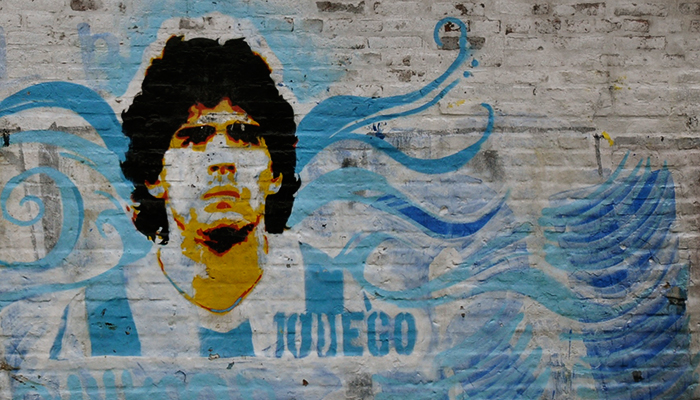
By José Gandue @Gandour
Speaking of deities, I always preferred the stories of the Greek gods, those celestial beings who, although powerful, had their rages and weaknesses. Those gods felt more human, closer to our glories and weaknesses. At the same time, I always felt a bit of distrust toward the figure of a single, untouchable, unequivocal god, one who could not be questioned, who never revealed himself, and who, in his pride, seemed destined to disappoint everyone through his apathy and eternal silence. It's clear that thinking this way, I will never reach the monotheistic paradise nor will I be welcomed in any of the contemporary temples, where they only talk about punishment for disobedience and insignificant rewards for the faithful.
Based on this, I know it bothers many people to say that Diego Armando Maradona is D10s (Never forget to include the numbers mentioned). They consider it an outrage, and every time "the fluffball" shows his vulnerability and reveals the mortality that we all, after all, contain, they get vilely and despicably excited. As if Diego had done them some harm, as if any of his actions had been carried out against them. It seems that one of his dribbles fractured their hearts or one of his goals shattered their hopes for love; otherwise, so much hatred is inexplicable. Some hypocrites feel entitled to judge and never forgive Maradona's recklessness and excesses, as if their lives were an undeniable example to follow or as if they could give moral lessons. However, what I most criticize in these kinds of senseless critics is... It's his lack of humor, his endless bitterness towards a character who managed to make millions of fans happy without even asking for their applause to celebrate.
I've been a devoted Maradona fan since Diego played in the 1979 FIFA World Youth Championship in Japan. He was only 19 years old., He warned the world at that time that there was a new figure on the sports scene. He read about his exploits in the copies of El Gráfico magazine that were sent from Montevideo to a Uruguayan classmate. This classmate, named Roberto, had cassettes with the narrations of his goals and pasted pictures of his celebrations in his notebooks. Then, in 1982, I suffered through Diego's expulsion against Brazil, as a consequence of his inexperienced anger, in a World Cup that was not yet his, but in which he was already announcing what was to come.
June 22, 1986. Mexico City. That's the day. Anyone who tells me they watched that match against England on TV and immediately realized that Argentina's first goal was a foul is a liar. But anyway, that's not the point. What happened next is one of the most exciting moments in the history of international sport. The best way to describe it was perfectly expressed live by the narrator Victor Hugo Morales:
«…he’s going to pass it to Diego, there he has it Maradona, he’s marked by two, Maradona steps on the ball, the genius of world football takes off down the right, and leaves the third one behind and he’s going to pass it to Burruchaga… Always Maradona! Genius! Genius! Genius! ta-ta-ta-ta-ta-ta-ta… and Goooooool… Goooool… I want to cry! Good Lord! Long live football! What a goal! Diego! Maradona! It’s enough to make you cry, forgive me… Maradona, in a memorable run, in the play of all time… cosmic kite… what planet did you come from? To leave so many Englishmen in your wake, to make the country a clenched fist, shouting for Argentina… Argentina 2 – England 0… Diegol, Diegol, Diego Armando Maradona… Thank you God, for football, for Maradona, for these tears, for this Argentina 2 – England 0…«
That day I was in the university residences where I lived for a couple of years while I began my studies in Political Science in Madrid. I was in a room full of provincial Spaniards who, for some stupid reason, hated everything that smelled of South America, And on the other hand, a few Latinos eager to laugh in the faces of those poor, resentful souls. It was the 55th minute of the match when this marvel unfolded before 114,580 fans at the Azteca Stadium and millions of television viewers who could do nothing but bow their heads and admit that what had happened was, at the very least, worthy of recognition for its extraordinary beauty. Yes, of course, that day in front of several angry Iberians, I cried and I was happy. There's no denying it.
Then came the two goals against Belgium and then that great pass to Burruchaga in the final against Germany. Then it was seeing a single man lead a team with few resources, a team that had previously lost., to be the winner of the Italian league, above the millionaires of the north. And yes, then tragedy struck, and at that moment we remembered that Diego was human., who could also fall into poverty.
I never understood, as I said before, the hatred that some have always felt and have tried to pass on to their children and their children's children. Those unfortunate people who celebrate every time a liar announces the death of the star, those who harbor that animosity cloaked in a false moral authority, do not excuse his cocaine-fueled past, his ironies, his political decisions, and especially the love that a people has for his figure. It pisses them off (yes, put like that, it pisses them off) that there are daring people who call him D10s and thank him for having filled some moments of their lives with joy. Anyway, all I'm saying is that they're missing out. I saw Maradona play and then I saw how generous he was with his words and his positive attitude. I decided from the beginning to like him, understanding and accepting his flaws. Diego Armando Maradona is an imperfect deity, mortal, fragile at times, But in many moments of my life, it brought out my best smile, and that's enough for me.