
By José Gandue @Gandour
I had a Uruguayan classmate in school, his last name was Gerstenblüth. He was a die-hard Peñarol fan. He would ask his friends in Montevideo to send him cassettes with the commentary of the "Aurinegros" matches, so he wouldn't miss a single detail of his team. Also, next to the tapes, curiously, the latest copies of El Gráfico would arrive, which, when I went to his house, I would sit and read for hours and hours., Although I didn't understand many of the details being described. It was 1979, and my Uruguayan friend spoke with devotion about a player who was barely of legal age. and he was already an idol for many on both sides of the Río de la Plata. He showed me a picture of this little boy jumping around in his Argentina national team jersey, celebrating one of his goals in the Youth World Cup in Japan. At that time, they called him "Pelusa," and without having seen a single broadcast of his games, I was already ready to celebrate his feats. Every time I went to Gerstenblüth's house, I found out the latest news about the career of this Argentinos Juniors player., from when he scored four goals against Loco Gatti after the goalkeeper called him "fatty"., and when, a few months later, he was acquired by Boca Juniors. In Colombia, in those days, on Saturday mornings they broadcast a program on television called Football, the best show on earth, where they showed summaries of matches from Germany, Spain, and occasionally Argentina. I think that was the first time I finally saw Diego play, wearing the Boca Juniors jersey. That's where I confirmed its magic.
In 1986, I was in my first year of university in Madrid, And at the beginning of summer I fully enjoyed the World Cup in Mexico, locked in the television room of the Colegio Mayor de Nuestra Señora de Guadalupe, my residence. Half of the inhabitants of that building were provincial Spaniards, many of them local gentry, where they were surely tolerated for the nonsense and contempt they hurled at anything that seemed different to them., and where they surely condoned their ignorance and racism. The other half was made up of "South Americans," mostly graduate students, one or two of whom are now somewhat famous for having been part of their country's government, of those who arrived in Spain with joy and were eaten away by nostalgia a few days after their arrival. Imagine that awful mix of tribes crammed into a 50-square-meter room, watching Argentina play England. You all know, of course, everything that happened that day at the Azteca Stadium., But in Guadalupe, it was a miracle that a pitched battle didn't break out on every play. The small-town gentry, those who before leaving their villages swore that those of us who came from across the seas were brutes, thieves, and rapists of their girlfriends, morally donned the robes of the British crown, and more than one celebrated Thatcher's "epic" in the Falklands. On the other side, a few Argentinians, yes, But most were Colombians, Peruvians, Ecuadorians, Mexicans, and Venezuelans., So offended by their counterparts, they adopted Maradona and his followers as their common symbol. And if you think about it, that scene of Diego symbolizing outsiders, renegades, and outcasts..., It was a constant everywhere on the planet.
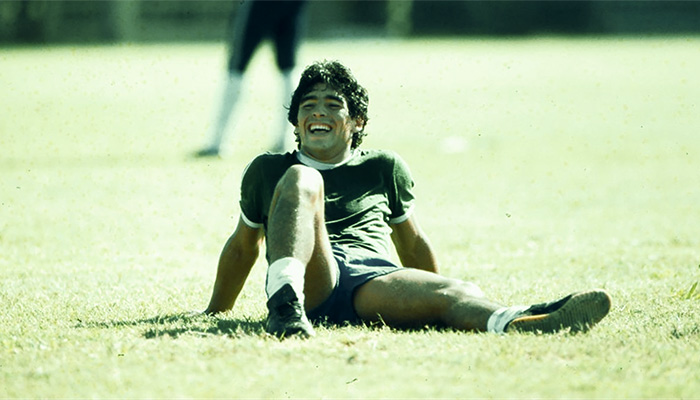
The match I enjoyed most during the 1990 World Cup was when Argentina played Italy. I watched it with my neighbor, a guy from Buenos Aires who brought a couple of friends over to his apartment in the Malasaña neighborhood. It was unbearably hot and we had the windows wide open, even though it was already night. Images of Maradona's ankle, swollen to the size of a baseball, were alarming. Italy took an early lead, with Salvatore Schillaci scoring in the 16th minute of the first half. As soon as the ball touched the net, we heard the roar of the neighborhood residents. To provoke them, we started chanting like a hooligan gang so that everyone who heard us would insult us. And then came the 67th minute and Claudio Paul Caniggia, with a header, beat Walter Zenga., And that's when the neighborhood really hated us, without even knowing where we were. Then came the penalties, and Sergio Goycochea became the hero, saving shots from Roberto Donadoni and Aldo Serena. The joy wasn't just Brazilian (no, my love). Diego's smile that day was ready to be framed and stamped on the heart.
Even to this day, being as sentimental as I am, I only remember three times when I've cried from sadness over sports-related matters. One of them was the day that Kareem Abdul Jabbar He played his last game on June 13, 1989, in the final game of the NBA Finals between the Los Angeles Lakers and the Detroit Pistons. His second appearance was on November 7, 1991, when Earvin "Magic" Johnson He announced that he had contracted HIV, and the third was when Maradona tested positive for ephedrine in the anti-doping test in 1994, in the United States, after the match against Greece. The day they "cut off his legs". That, added to what happened with Andrés Escobar, made it a horrible World Cup.
I always adored, admired, and loved Diego Armando Maradona. I always laughed at his legendary quips, I celebrated every one of his remarks against the powerful figures at FIFA, his ironic jabs at the occasional nefarious political figure. I understood, though I didn't agree with, many of his endorsements of other world leaders. Anyone in his place would have adopted the most comfortable position, the one taken by colleagues like Pelé, Platini, Beckham. After all, they are footballers, not insurgents, and what has always been asked of them is to play well, excite their fans, and accept the reality of the world as it is. No one is saying these players did anything wrong. On the contrary, they did everything right to an extraordinary degree. They never bit the hand that fed them. They never uttered a peep in the face of power. But still, how many popular anthems did they compose for Pelé?, How many fans tattooed Platini's image on their chests?, How many stadiums honestly and sincerely bear Beckham's name on their gates? Excuse me, but I'm on the side of Cantona, Cruyff, and Mágico González., Those who knew from the beginning that the game went beyond the dance of millions, The grand sponsorships, the respectful greetings to leaders, and the resignation in the face of cruelty. And I place before them, on a pedestal reaching to the heavens, the one and only Diego.
And to those who feel so pure and so worthy, those who always detested Maradona for his incidents, for his mistakes, for his outbursts, those which from their most hypocritical pulpits they labeled as rude and provocative, I say: I understand them. I'm sure their idols always behaved in the most appropriate and worthy manner, worthy of being commended in impeccable golden letters. I respect them. But I prefer a guy who, with all his clumsiness and sins, produced in me the best of smiles and the loudest of my celebratory shouts. He was as human as all of us, but he was also the only God I ever saw in my life and I will miss him.
Postscript: I recorded this podcast about Maradona a few months ago. I invite you, if you'd like, to listen to it again.