
By Maria Conchita Acuña @conch1ta
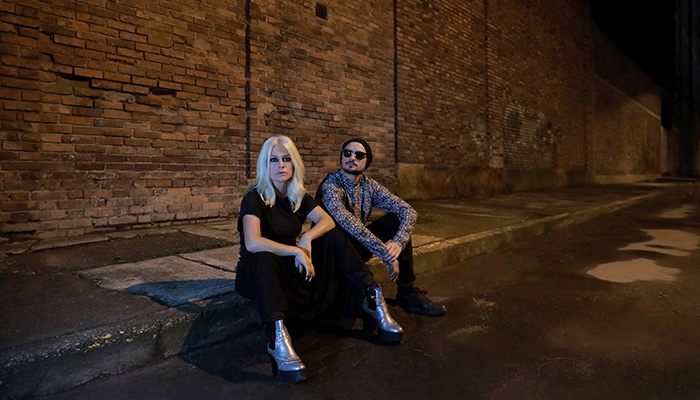
Bimol It's a Colombian electronic music band that has gradually been gaining recognition within the genre. The band consists of Donna Lace (voices) and Theo Jah Leon (producer), both from Bogota, each with an individual musical journey that ranges from the hip-hop until the hard techno. The universe brought them together, not only to form Bimol but also to be a couple., Donna y Theo They have a solid relationship of more than six years, a factor that has undoubtedly allowed them to get to know each other as artists and have a meeting point that transcends the commercial and is manifested in their creations; love for each other, love for what each one does and love for music, for Bimol.
What is Bimol?
We are a project that, in essence, aims to create a hybrid between machines and vocals. Our approach is to flow with the live performance, exploring the many textures and genres that have been fundamental to our artistic development. We want to break free from labels and subgenres of electronic music, while acknowledging that techno is a major influence. Our contribution to music transcends trends; our personal style, the message we want to convey through our lyrics, and the connection we seek to forge with our audience always take precedence.
How does the hybrid between machines and voices work in a live show, how does it develop?
The voice is the common thread of our show; it's what generates the tension and the moments of the performance. The machines set the rhythm, they are the foundation, they are our groove, they create the atmosphere—one cannot exist without the other. Let's say the voice is the human touch, visceral and organic.
How do they break free from musical labels while still retaining techno as an influence?
At this point specifically, it's the voice that makes the difference. We build upon our techno influence and transform it through the vocals, creating a new sound with Spanish vocals and original lyrics. We want to move away from the 'party' image that techno has always been associated with. techno, To go further. We have to give this genre the opportunity to metamorphose, taking it out of its label and experiencing it more broadly, as music itself; it's a blank canvas on which one can always write whatever one wants. For example, our first album is about that: rescuing the sensitivity of techno, transcending the physical (which touches the soul through sound) towards the introspective, which touches the mind, the emotions.
In this quest to transcend the physical, what has been the most significant challenge?
Each of us has spent over fifteen years immersed in the electronic music scene. Our challenge is to respect the codes of a culture that isn't strictly Colombian and contribute from our own experience. We want to share our own vision. We consume the movement, we digest it, and we release our own version.
Tell us about your creative process, how do you arrive at the final result?
The fact that we are a couple has allowed us to get to know each other as artists, human beings, and professional musicians. This has given us the opportunity to have more time and space to explore music; we can afford to have hours and hours of jam In our own home, which is our creative factory. Plus, we live in a place where we don't get bothered (laughs). We don't really have a set method; we flow a lot with our own emotions, our moods, and our daily lives. Sometimes someone has an idea, and we start developing it. It's hard to explain how we design what we do; a lot of it comes from the flow of the moment. The sound is born and generates itself; it builds itself. That's our method: the flow. For example, Diana sometimes gets lyric ideas at certain moments, and to capture the moment, she records them, and then we use them. Other times, Theo has a demo, and then we add vocals. It's random.
His first album is called Our World, What is the world of Bimol?
It's a real and sensitive world, one that respects individual ways of being. It's free. We champion the principle of 'listening to others,' of not labeling or categorizing. Everyone's knowledge is important and deserves to be shared. Our environment is sometimes hostile, but we use that very quality as inspiration. We try to soften it by taking the positive from everything; we are enriched by everything, everything is raw material, we take nothing for granted. Mental flexibility is an important factor. We don't compete with anyone because, from the outset, we are nourished by everything around us. The Universe is vast in its manifestations; we cannot ignore them, it doesn't even cross our minds, we are grateful for them.
At the beginning they mentioned genres and textures that have been a fundamental part of their artistic training, what is that background?
For me (Diana), my contact with electronic music came from a young age, for example... house From the 80s. There was a time when all-girl live acts were groundbreaking, they were a real inspiration. I (Diana) had the opportunity to work closely with pioneers like Camila (Resident DJ of The RoomElectro was the gateway to the whole female vocal movement; it was house. Sharing the stage with an icon of house and of electronic music as BlackBox It was indescribable; I can't get over the pleasure I feel for it. retro. My career as a singer hasn't only taken place on the electronic music stage; I used to sing covers of legendary bands, the background It is very spacious.
For me (Theo), my first contact with music was through my parents with classic rock, for example. Led Zeppelin. Then I started to discover my own sound, my tastes; that's when I got closer to hip-hop, I really liked its sound and message, especially the one from the western side of the United States, the rap protest. Around 1998 I started having my first contact with electronic music; I remember my first rave was seeing... Samuel L Sessions, From there I started researching the electronic sounds that I liked, Sven Vath, Richie Hawtin, Carl Cox, etc. Little by little I got into the sound of the techno until reaching hard techno, With this genre, I began to develop my personal project. Then I discovered the groups that are still a personal reference point for me today., Aphex Twin, Amon Tobin, etc. Since Bimol started, I've begun to meet a lot of artists and producers who have musically influenced me and are an inspiration at this time.
Where is Bimol headed, what's coming in 2018?
Bimol has been studying and researching sound for quite some time, and we're clearly finding our way. 2018 will most likely be a very introspective year, focused on exploring the sounds and textures we like, looking inward. All of this is linked to... live act And that's where we want to place our bet and move up; we believe that the staging of live act That's what sets Bimol apart, and it's also where the inspiration for creating new music comes from. 2018 will be about working on the project. live act, to make ourselves known in different cities across the country and to take our project to other countries.